
Smart Check-In: How to Reduce Cancellations and Boost Reviews on Airbnb and Booking
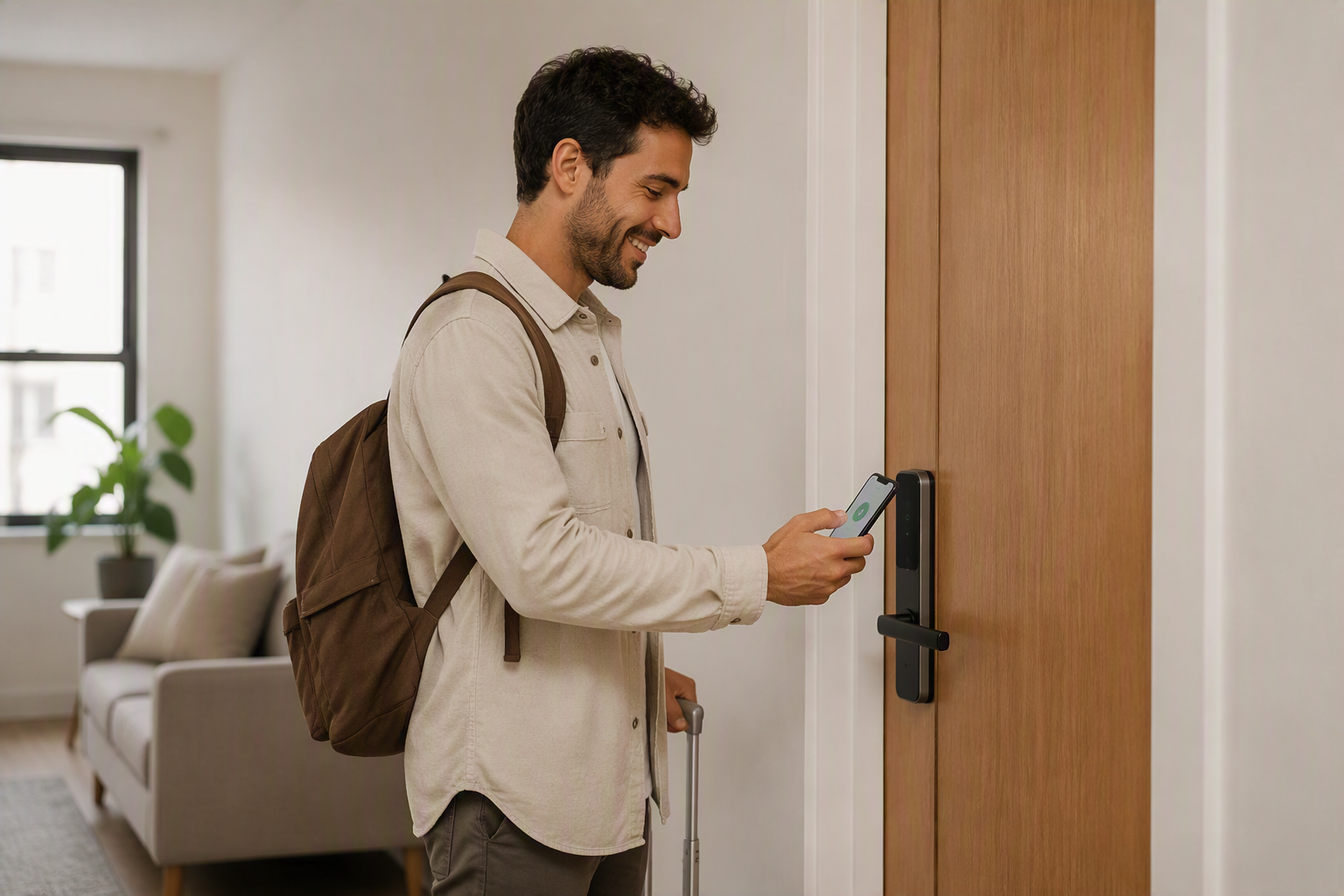
The revolution of access to holiday accommodation
The holiday rental sector has undergone an unprecedented transformation over the last decade. What was once considered an acceptable service — such as waiting for the host at the door at an agreed time — is today viewed by many travellers as a source of stress and friction. In the era of immediacy, guests look for autonomy, flexibility and hassle-free processes.
This is where self-guided and digital access comes into play. Implementing a modern system is not only a convenience for the owner, but has also become a critical factor for the commercial success of any property on platforms like Airbnb, Booking.com or Vrbo. The way a guest accesses your property for the first time sets the tone for their entire stay. If the process is chaotic, confusing or restrictive, the likelihood of receiving a negative review or even suffering a last-minute cancellation skyrockets alarmingly.
Throughout this article, we will analyse in depth how transitioning to a smart entry model can protect your income, optimise your daily operations and position your listings at the top of search algorithms.
Why does traditional check-in increase last-minute cancellations?
To understand the value of automation, we must first identify the pain points of the traditional key-handover model. Last-minute cancellations are one of the biggest fears for any property manager, as they leave a gap in the calendar that is very difficult to fill in just a few hours. Surprisingly, many of these cancellations are directly related to uncertainty and poor communication during the arrival process.
Traveller anxiety and the lack of quick responses
Imagine a traveller who has just landed in an unfamiliar city after a six-hour flight. Their luggage is heavy, they are travelling with children, and their main wish is to reach the accommodation, shower and rest. If, at that crucial moment, the host does not reply to messages, or if the instructions to meet at the entrance are ambiguous, the guest's anxiety level rises exponentially.
Many guests, fearing they will be left without accommodation or stood up, choose to cancel the booking under the platform's flexible policies and look for a hotel with a 24-hour reception. The lack of a clear, predictable system generates instant distrust.
Rigid schedules versus travel mishaps
Travel is full of uncontrollable variables: flight delays, heavy traffic, mechanical breakdowns or lost luggage. When a host demands a strict arrival time (for example, from 16:00 to 20:00) due to their own schedule limitations, they transfer all the pressure to the customer.
If guests realise they will arrive outside those hours and the host charges them a "late check-in" fee or, worse still, tells them they cannot be accommodated until the following day, cancellation is almost inevitable. Customers prefer to lose some of their money or find alternative accommodation that offers the flexibility their situation requires.
The psychological impact of self-guided access on the modern traveller
Trust is the currency of the sharing economy. When a user books a holiday home, they are making an act of faith: they trust that the photos are real, that the place is clean and that they will be able to enter without any problems. Smart access acts as a digital anti-anxiety pill for the guest.
A sense of control and security
Knowing in advance that they have a unique access code or a digital key that activates automatically at check-in time eliminates uncertainty. Guests feel they have absolute control over their trip. They do not have to worry about arriving late, disturbing the host late at night, or having to engage in awkward social chit-chat when they are exhausted.
The perception of professionalism from minute one
An automated entry process immediately conveys the image of a professional and well-managed business. It does not look like the flat of an improvised individual, but rather a top-tier holiday accommodation that uses cutting-edge technology to guarantee customer comfort. This positive first impression predisposes guests to be more tolerant of small details that may arise during the stay and to rate the accommodation much more positively in satisfaction surveys.
How smart check-in drastically reduces cancellations
The link between an automated entry system and reduced cancellations is not a mere assumption; it is backed by consumer behaviour data. By removing friction, we reduce the triggers that lead customers to regret their purchase.
Immediate confirmation of arrival instructions
When a guest makes a booking, especially a last-minute one, they need visual and written confirmation that everything is ready. Integrated management systems allow you to immediately send the exact instructions on how to get there and how to enter the property. Seeing that the process is automated makes guests feel secure and dismisses any thoughts of looking for booking alternatives.
Elimination of late arrival surcharges
The "late check-in fee" is one of the policies most disliked by Airbnb and Booking users. It is perceived as a financial penalty for circumstances that are often beyond their control. By implementing smart locks, there is no need for a physical person to wait at the property, allowing these fees to be eliminated entirely. This makes your accommodation much more competitive and attractive for last-minute bookings, which are often highly lucrative.
The secret to boosting your ratings on Airbnb and Booking
Booking platforms use highly strict rating systems. A decimal point difference in your average score can mean appearing on the first page of results or being relegated to oblivion. Check-in is one of the sub-factors that guests rate individually, and it carries huge weight in the overall rating of the stay.
Five stars are earned in the first fifteen minutes
There is a psychological phenomenon known as the "primacy effect", which proves that humans remember the first moments of an experience with the greatest intensity. If entry to the accommodation is smooth, fast and trouble-free, the guest's brain labels the experience as "excellent". From then on, they are much more likely to overlook minor details, such as slightly worn tableware or a view that was not quite as expected. Conversely, if arrival was an ordeal, guests will inspect the house with a magnifying glass, looking for flaws to justify their initial frustration.
Reduction of negative reviews due to communication issues
Analysing one- or two-star reviews on Airbnb, an overwhelming percentage mention phrases like: "The host didn't show up", "We had to wait an hour in the street in the rain" or "We couldn't contact anyone to get the keys". By automating access, you eliminate the variable of human error. Technology does not oversleep, is not late due to traffic, and does not forget to send a message.
The winning combination: Communication and automated registration
For smart check-in to be truly effective, it is not enough to just install an electronic lock; it must be perfectly integrated into a digital workflow that covers customer communication and compliance with current legal regulations.
The importance of automated legal registration
In many countries, such as Spain, legislation requires identifying all adult guests and submitting their data to the authorities (Police, Guardia Civil or the SES.HOSPEDAJES system) within a very strict timeframe. Carrying out this process manually upon the guest's arrival is time-consuming and breaks the magic of self-guided entry.
The ideal solution is to integrate automated check-in with your management software. This way, guests can complete their identity registration, sign the entry form and upload their ID digitally before arrival. Once this mandatory step is completed, the system automatically releases the access code to the property. This guarantees 100% compliance with the law without the need for physical interaction or wasting valuable time.
Keep the guest constantly informed
Entry automation must be accompanied by a proactive communication strategy. Do not make guests have to ask how to enter. Using an automated messaging system for guests allows you to schedule strategic messages at key moments:
- Immediately after booking: Welcome message confirming that the accommodation has flexible, self-guided access.
- Three days before arrival: Link to complete the online guest registration and submit legal details.
- The day before arrival: Detailed access instructions (codes, maps, parking directions) sent once identity registration is verified.
- The day of departure: Simple instructions for leaving the property and a reminder of the check-out time.
This constant flow of information eliminates guest uncertainty, drastically reduces the number of queries you have to answer manually and generates an outstanding user experience.
How to implement a smart check-in system step-by-step
If you are convinced about making the leap to automation, it is important to plan the transition to ensure that technology works in your favour and does not become a source of technical issues. Here are the essential steps to carry it out successfully:
1. Choose the right hardware for your property
Depending on whether your accommodation is a flat in a residential block, a detached house or a room in a coliving space, you will need to choose different hardware solutions:
- Smart Locks: These are installed directly over the existing lock on the property door. They allow opening via Bluetooth, numerical codes or mobile apps. Brands like Nuki or Yale are leaders in this sector.
- Wall-mounted keypads: These are the most recommended option to avoid guests having to download additional mobile apps. They only need to enter a 4- or 6-digit code generated specifically for their stay.
- Smart Keyboxes: If you cannot modify the door lock, a smart keybox anchored to the exterior wall or an authorised area is an excellent alternative. The guest enters a digital code to open the box and retrieve the physical key.
- Communal entrance systems: If your flat is in a building with a shared entrance, there are devices that connect to the property's intercom (such as Nuki Opener or Ring Intercom), allowing the street door to be opened from the guest's mobile phone or via a call pattern.
2. Integrate the hardware with your PMS (Property Management System)
Having a smart lock is of little use if you have to manually generate and send codes for each new booking. The real magic happens when you integrate your access devices with a management platform like Macufy. By connecting both systems, the software takes care of creating a unique code for each guest that will only be valid from the check-in time of their booking until the check-out time. Once the guest leaves, the code is automatically deactivated, ensuring the security of the property.
3. Write clear, visual and simple instructions
Even the most advanced technology can fail if the instructions for use are confusing. Do not assume all guests are tech-savvy. Design an arrival guide that includes:
- Real photographs of the entrance and the property door.
- Step-by-step explanations of how to enter the code (for example: "Enter the 6-digit code and press the hash key #").
- A short 15-second video showing the actual opening process.
- A clear contingency plan (for example, a 24-hour support phone number or the location of an emergency physical key).
Operational benefits for the host and property manager
So far we have talked about the impact of smart check-in on the guest experience, but the benefits for the owner or manager are equally transformative. Automating this process gives you back control of your time and allows you to scale your business.
Reclaim your freedom and free time
Managing a holiday let in a traditional way can quickly become a 24/7 job. Waiting around due to flight delays, midnight calls because a guest cannot find the key, or the need to physically travel for every handover consumes your energy and limits your personal life. With self-guided access, your physical presence is no longer required. You can manage your properties from anywhere in the world, knowing that the system works autonomously for you.
Scalability without increasing staff costs
If your goal is to grow your portfolio of holiday properties, the traditional model is unsustainable on a large scale. Managing physical key handovers for 10, 20 or 50 properties requires hiring a team of people dedicated exclusively to this task, which drastically reduces your profit margins. Automation allows you to manage dozens of properties with a minimal staffing structure, maximising the profitability of your business.
Greater security and access control
Traditional physical keys present serious security flaws: they can be lost, they can be duplicated without your consent at any hardware shop, and they do not keep any record of who has entered the property. Smart locks solve all these problems:
- Real-time access history: You will know exactly what time the guest entered, what time the cleaning team left, and if there is unauthorised staff on the property.
- No possibility of duplicates: Since there are no physical keys in circulation, you eliminate the risk of unauthorised copies that could compromise the safety of future guests.
- Instant access cancellation: If a guest decides to extend their stay without paying or if a conflict arises, you can revoke their access code immediately from your mobile phone.
Case studies: Before and after automation
To illustrate the real impact of this technological shift, let us analyse two common scenarios that occur daily in holiday let management.
Scenario A: Traditional manual check-in
Carlos manages a lovely flat in the centre of Madrid. A group of guests is scheduled to arrive at 18:00. Carlos travels to the flat at 17:45 to welcome them. At 18:15, the guests have not arrived. Carlos sends them a message and finds out that their flight has been delayed and passport control is backed up. New estimated arrival time: 21:30.
Carlos has to cancel his personal plans for the evening and go home, only to return later. Finally, the guests arrive at 22:00, tired and grumpy. Carlos has to collect the tourist tax and register their identity details on the police portal in the building's entrance hall, in poor light and in the rain. The guests enter the flat frustrated, and Carlos returns home tired, having lost the entire evening.
Result: Stressed guests, exhausted host, high likelihood of a 4-star rating or lower due to the poor arrival experience.
Scenario B: Automated smart check-in
Marta manages a flat identical to Carlos's, but uses a system integrated with Macufy and smart locks. Three days before arrival, her guests complete the digital guest registration from their mobile phones while waiting at their airport of origin. The system validates their identities and automatically sends them the access instructions with a unique code that will activate at 15:00.
The guests' flight is delayed and they arrive at the flat at 23:30. They do not need to notify Marta or worry about the time. They arrive at the door, enter the code they received on their mobile and enter the accommodation immediately. The system registers the entry and sends an automatic notification to Marta, confirming that the guests have accessed safely. Marta enjoys her family dinner uninterrupted.
Result: Guests delighted with the ease of access, stress-free host, legal process successfully completed and a high probability of receiving a 5-star review praising the comfort and excellent organisation of the accommodation.
Overcoming common objections to automation
Despite the obvious benefits, some owners are still reluctant to make the leap to automation due to certain myths or unfounded fears. Let us debunk the most common objections:
"Automation dehumanises the service"
Many hosts fear that dispensing with a physical welcome makes the service seem cold and impersonal. The reality is that hospitality is not about handing over a physical key, but about being available when the guest needs you. By freeing up your time from the repetitive task of key handover, you can dedicate more energy to offering high-quality, personalised attention: recommending local restaurants, answering questions quickly via chat, or preparing personalised welcome details inside the house. Guests value the convenience of self-guided entry far more than having to engage in forced conversation after a long journey.
"What happens if there is a power cut or the Wi-Fi fails?"
This is one of the most common technical fears. However, professional-grade smart locks operate on independent internal batteries that do not rely on the house's electrical grid and use local communication protocols (such as Bluetooth or offline encryption similar to bank card machines). This means the lock will continue to work perfectly and recognise authorised access codes even if there is a power cut or the property's router is disconnected.
"My guests are elderly and won't know how to use the technology"
The key to avoiding this problem is choosing the right access method. Avoid forcing your guests to download complex apps or register on third-party platforms. Using a physical keypad on the door is a solution universally understood by people of all ages. Entering a numerical code is as simple as dialling a phone number or using an ATM, ensuring that any customer, regardless of their familiarity with technology, can access without any difficulty.
Conclusion: Smart check-in is not the future, it is the present
In a market as competitive as holiday rentals, the difference between success and stagnation lies in the ability to adapt to the demands of the modern consumer. Self-guided access and automated communication have ceased to be exclusive features of luxury hotels or large property management corporations, becoming a minimum standard demanded by travellers.
Implementing a smart check-in system not only protects your income by drastically reducing last-minute cancellations and improving your reviews on Airbnb and Booking.com, but it completely transforms your lifestyle as a host. It allows you to reclaim your time, eliminate operational stress and focus your efforts on what really matters: growing your business in a sustainable and profitable way.
If you want to delve deeper into how to optimise the management of your properties, we invite you to consult industry reference sources such as the Airbnb Help Centre or the optimisation guides on the Booking.com Partner Hub, where the impact of technology on customer satisfaction is constantly analysed.