
Remote Check-In for Holiday Apartments: The Complete Guide
The Keyless Access Revolution in the Tourism Sector
The holiday rental sector has experienced an unprecedented transformation over the last decade. Digitalisation has not only changed how travellers book their stays, but also how they interact with accommodation upon arrival. In this scenario, remote access management has established itself as one of the fundamental pillars for the operational success of any short-term rental property.
The traditional in-person key handover, whilst warm and personal, presents significant limitations in a globalised and dynamic market. Flight delays, unexpected arrival times, and the need to balance the work and personal lives of property owners have driven the mass adoption of technological alternatives. Today, offering self-check-in is no longer an optional added value, but a standard expectation for most guests, especially business travellers and the new generation of digital tourists.
Implementing an efficient remote access system not only improves guest satisfaction from the very first minute, but also drastically optimises the operational costs of management companies and independent hosts. Throughout this article, we will analyse in depth how this technological ecosystem works, its legal implications, the best tools on the market, and how to overcome the most common logistical challenges.
What is Remote Check-In and How Has It Evolved?
The concept of self-check-in refers to the set of processes and technologies that allow a guest to access their holiday accommodation without the owner, manager, or receptionist needing to be physically present to hand over the keys. This process ranges from the prior verification of the traveller's identity to the physical opening of the property's doors.
In the beginning, this system relied on very simple analogue methods, such as the famous combination lockboxes hung on facades or entryways. Although effective at the time, these solutions posed serious security issues, as the code was usually the same for all guests and physical keys could easily be duplicated or lost. Furthermore, many municipal ordinances have begun to ban these lockboxes on public streets for aesthetic and public safety reasons.
Technological evolution has paved the way for smart, interconnected systems. Today, self-check-in relies on state-of-the-art electronic locks, mobile applications, facial recognition systems for document validation, and integrated software platforms that automate the entire workflow. This transition has not only bolstered property security but has also allowed strict compliance with current legal regulations regarding guest registration.
How the Self-Check-In Process Works Step-by-Step
To ensure the guest experience is seamless and does not cause friction or anxiety before arrival, the digital reception process must be structured logically and automatically. Below, we break down the key phases of an optimal workflow:
1. Booking Confirmation and Start of the Digital Flow
The process begins the very moment the booking is confirmed, whether through direct channels or platforms like Airbnb, Booking.com, or Vrbo. Instantly, the system should send a welcome message to the guest explaining that the accommodation features a secure self-check-in system. This first contact is vital to convey reassurance and professionalism.
2. Data Collection and Identity Verification
Before providing any access code, it is mandatory to collect information from all adult guests staying at the property. This step includes:
- Capturing photos of both sides of the identity document or passport.
- Verification via facial biometrics (a user selfie to check against the document).
- Completing the personal details required by local authorities (first name, surname, date of birth, nationality, document number, etc.).
3. Digital Signing of the Holiday Rental Agreement
Although many booking platforms already include terms and conditions, having a specific, digitally signed holiday rental agreement is an excellent practice to protect the property against potential incidents. During the online registration process, the agreement is presented to the guest to sign directly on their mobile device screen.
4. Generation and Delivery of Access Credentials
Once the guest has completed their registration and it has been validated, the system automatically generates the access credentials. Depending on the technology installed in the apartment, these credentials can be:
- A temporary, unique numerical code for the smart lock keypad.
- An invitation link to open the door via a mobile or web app.
- A temporary virtual key activated via Bluetooth connection.
It is essential that these credentials only activate at the exact scheduled check-in time and automatically deactivate at check-out.
5. Arrival at the Accommodation and Door Opening
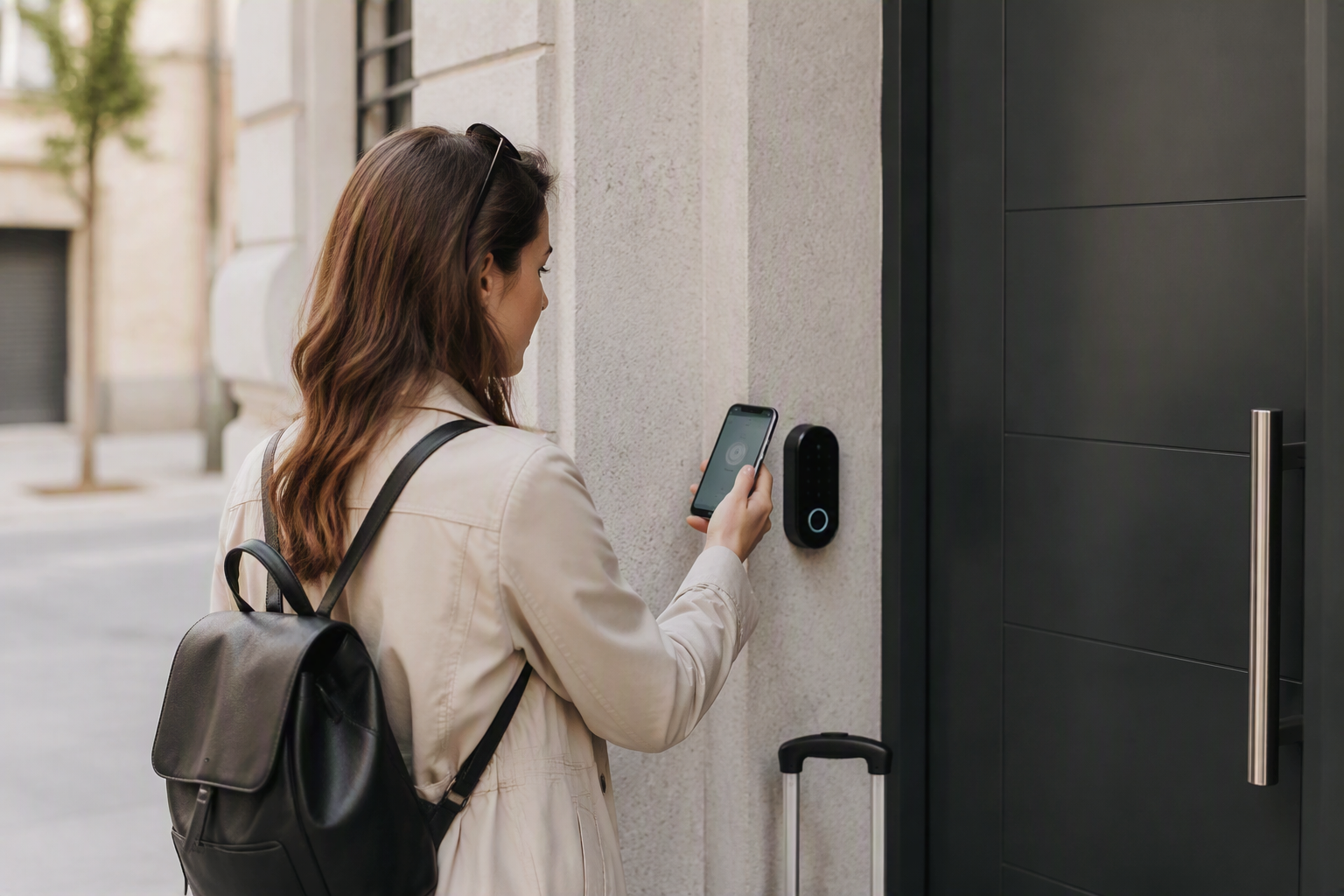
Upon arriving at the building, the guest uses the received credentials to open both the communal main entrance (if the building has a compatible system) and the apartment's front door. The process should be as simple as typing a four or six-digit code or pressing a button on their smartphone.
Operational Advantages of Access Automation
Adopting this management model is not just a response to market demands, but a strategic decision that brings countless benefits to holiday accommodation owners and managers.
Elimination of Waiting Times and Scheduling Flexibility
One of the biggest points of friction in holiday rentals is delays. If a guest's flight is delayed by three hours and they arrive at two in the morning, an owner doing an in-person handover is forced to wait at the apartment or charge a 'late check-in' fee, which usually causes guest annoyance. With remote access, the guest can arrive at any time they wish without pressure, and the manager does not have to sacrifice their rest.
Drastic Reduction in Staff Costs
For agencies managing dozens or hundreds of properties, deploying staff to hand over physical keys represents a massive logistical and personnel cost. Automating this process allows operations to be centralised, freeing up human resources for higher-value tasks such as quality control, cleaning, or personalised guest support during their stay.
Greater Security and Key Inventory Control
Traditional physical keys are easy to lose and simple to duplicate at any local locksmith without the owner's consent. This poses an obvious security risk for future guests. By implementing smart locks, 'keys' are purely digital and temporary. There is no risk of unauthorised copies, and a real-time audit log is kept, showing precisely which code was used to open the door and at what exact time.
Optimisation of Communication and Support
Digitalisation allows communications to be standardised and scheduled. You can schedule these instructions using automated guest messaging tools that trigger at key moments, ensuring travellers receive the information they need exactly when they need it, reducing last-minute support calls.
The Legal Framework of Guest Registration and Public Safety
One of the most critical aspects and one that raises the most doubts among holiday let owners is compliance with legal regulations when not conducting an in-person reception. The law requires the reliable identification of all persons staying in tourist accommodation.
Royal Decree 933/2021 in Spain
In the Spanish context, national public safety regulations oblige landlords to register travellers' identity details and transmit them to the State Security Forces and Bodies databases (National Police, Civil Guard, or the corresponding regional police forces). With the entry into force of Royal Decree 933/2021, information requirements have become much stricter and more detailed.
To comply with the law without an in-person key handover, it is essential to use certified digital tools that allow you to:
- Perform an optical character recognition (OCR) scan of identity documents to avoid manual transcription errors.
- Verify that the presented document is authentic and belongs to the person completing the process.
- Collect the guest's handwritten digital signature on the entry form.
- Automatically send the collected data to police platforms within 24 hours of the start of the stay.
To meet all these requirements without losing your mind, having an automated check-in system is essential, as it seamlessly connects your bookings with the relevant government platforms, ensuring your activity always operates within current legality.
Data Protection (GDPR) in Identity Management
By collecting identity documents, photographs, and signatures, owners handle highly sensitive personal data. It is of vital importance to strictly comply with the General Data Protection Regulation (GDPR). This involves:
- Using verification platforms that store information on secure, encrypted servers.
- Not storing images of identity documents on personal devices such as mobile phones or computer folders without proper protection.
- Clearly and explicitly informing the guest about the use, storage, and subsequent destruction of their personal data in accordance with established legal timeframes.
Key Technologies for Implementing Keyless Access
To design a robust and reliable remote reception system, it is necessary to select the right technology combination based on the property type (apartment in a residential building, detached house, etc.) and the available budget.
Smart Locks
These are the heart of the system. They are installed on the property door and allow motorised locking and unlocking. Different technologies exist depending on the communication method:
- Wi-Fi Locks: They connect directly to the accommodation's network, allowing them to be controlled in real time from anywhere in the world. They are ideal for instantly generating access codes and checking the door status.
- Bluetooth Locks: They require the guest to be near the door to open it via a mobile app. They consume less energy than Wi-Fi locks but limit real-time remote management unless installed alongside a gateway.
- Standalone Keypads: This is the most practical and universal solution. The guest only needs to type a physical code to enter, preventing them from relying on their mobile phone battery or their network operator's data coverage.
Opening Systems for Communal Main Entrances
In the case of apartments located within residential buildings, access to the property consists of two barriers: the building's communal main entrance and the apartment's own door. Resolving access to the communal entrance is one of the greatest technical challenges.
To solve this, there are devices installed invisibly inside the property's intercom or buzzer. These systems allow guests to open the communal door by making a missed call from a pre-registered number, typing a code on the external intercom, or via a temporary web link that triggers the building's electric door release securely and without altering the communal installation.
Identity Verification Gateways with Artificial Intelligence
To guarantee that the guest is who they say they are, modern tourism management tools integrate verification gateways that analyse the validity of official documents (IDs, passports, driving licences) using artificial intelligence algorithms. These technologies detect digital tampering, expired documents, or forgeries in a matter of seconds, providing a level of security far superior to human visual checks.
Comparison Table of Remote Access Methods
Below, we present a table summarising the main advantages and disadvantages of the most common access methods today:
| Access Method | Security Level | Guest Experience | Installation Cost | Technical Requirements |
|---|---|---|---|---|
| Smart Lock + Keypad | Very High | Excellent (No app or smartphone required) | Medium-High | Batteries and internet connection (optional but recommended) |
| Mobile App Opening (Bluetooth) | High | Good (Requires downloading app and having battery) | Medium | Guest's smartphone with active Bluetooth |
| Key Safe / Lockbox | Low | Fair (Can be difficult to open at night) | Very Low | None (Purely mechanical installation) |
| Door Release via Call / Web Link | Very High | Excellent (Fast and contactless access) | Medium | Device connected to the intercom |
Common Mistakes When Implementing Self-Check-In and How to Avoid Them
Although technology greatly facilitates daily management, poor planning or choosing the wrong tools can lead to frustrating operational issues for both guests and the management team. We analyse the most common mistakes and the best strategies to prevent them:
1. Sending Overly Complex or Lengthy Access Instructions
A very common mistake is writing endless manuals with confusing screenshots and dense text. When a guest arrives tired after a long journey, the last thing they want is to decipher a complex instruction manual just to get inside and rest.
The solution: Create simplified visual guides. Use videos of no more than 30 seconds clearly showing how to type the code on the door or how to open the building's communal entrance. Keep text to a minimum, using bullet points and bold text to highlight critical steps.
2. Not Having an Offline Contingency Plan
Technology can fail. A power cut in the area, a drop in the property's internet service, or simply the guest's mobile phone running out of battery or data coverage upon arrival can leave the customer locked out.
The solution: Always choose hybrid systems that work locally without needing an active internet connection (for example, electronic locks that generate offline codes using time-synchronisation algorithms similar to bank tokens). Likewise, always maintain an emergency telephone communication channel operational 24 hours a day.
3. Neglecting Device Battery Maintenance
Smart locks and keypads run on batteries or alkaline cells. If preventive monitoring is not carried out, the device can shut down completely at the most inconvenient moment, preventing access to the property.
The solution: Set up automatic alerts in your management software to notify you when any device's battery level drops below 20%. Also, ensure that the selected locks have external emergency terminals that allow a 9V external battery to be connected from outside the door to temporarily power the system and enter the opening code in case of total discharge.
4. Completely Dehumanising the Welcome Experience
Process automation should not translate into coldness or a lack of hospitality. Many guests highly value human contact and local advice during their holidays. A 100% robotic and soulless check-in process can result in four-star reviews instead of five.
The solution: Compensate for the physical absence with warm, friendly, and highly proactive digital communication. Send personalised local recommendations about restaurants, transport, and activities in the area. Leave a physical welcome gesture inside the apartment (such as a handwritten note, a bottle of fresh water, or local products) so that guests feel your hospitality from the moment they step through the door.
How to Choose the Right Management Software for Your Business
For the implementation of remote access to be truly profitable and scalable, it is not enough to just buy a smart lock from an online shop. The real value lies in integrating all components into a unified Property Management System (PMS).
A good management software should act as your business's operations hub, allowing you to connect your direct sales channels and OTAs with your physical access devices and identity verification tools. When evaluating different software options on the market, ensure they meet the following indispensable requirements:
- Native integration with leading locks: The software must synchronise directly with recognised brands in the smart lock sector (such as Nuki, Tedee, Yale, Salto, or TTLock) to generate and revoke access completely automatically and without intermediaries.
- Communication automation: Ability to send personalised templates via email, SMS, or WhatsApp based on the booking status and the traveller registration process.
- Intuitive control panel: A clear interface that allows your cleaning and maintenance team to know in real time if guests have already left the property (thanks to the lock closure log), facilitating the organisation of work shifts and improving overall efficiency.
In conclusion, remote check-in has ceased to be a future trend and has become an imperative necessity in the present of holiday accommodation management. By combining smart access technology with automated communication and strict compliance with legal regulations, you will not only protect your property and optimise your operational costs, but also offer your guests the fast, convenient, and secure arrival experience they truly expect on their travels.