
Energy Efficiency in Tourist Accommodation: Cost Reduction Guide
The New Horizon of Hospitality: Sustainability, Profitability and Unforgettable Experiences
The tourism and temporary accommodation sector is at the peak of a revolution. What was once considered added value has today become an imperative need: sustainability and efficiency in consumption management. The growing volatility of energy prices, combined with an increasingly deep-rooted ecological awareness among travellers, has catapulted consumption management in tourist accommodation to the top of the priorities for owners and managers of holiday rentals, rural houses and hotels.
Implementing resource optimisation measures is not just an ethically responsible decision, but an indispensable financial strategy to shield profit margins and ensure long-term competitiveness. In a market where every pound counts and online reputation is the most valuable asset, offering sustainable and profitable accommodation translates into an unbeatable competitive advantage.
Today, the modern traveller does not just look for comfort and a good location; they also prioritise establishments that demonstrate a real commitment to the environment. The data confirms this: according to various tourism sector studies, more than 70% of global travellers prefer to book sustainable accommodation, and a significant percentage are even willing to pay slightly more for it. This trend is not fleeting; it is the foundation of the eco-tourism of the future, a future where energy efficiency in tourist accommodation and carbon footprint reduction are as important as the quality of the sheets or the speed of the Wi-Fi.
In this comprehensive guide, we will break down step-by-step how to transform your property into a highly efficient space, detailing proven strategies to drastically reduce utility bills without sacrificing a single bit of comfort or the quality of the guest experience. From the initial energy audit to the integration of renewable energy in tourism, we will provide you with the tools and knowledge to make your sustainable and profitable accommodation not just a slogan, but a tangible reality that benefits both your pocket and the planet.
Energy Audit: The Indispensable Starting Point for Efficiency
Before embarking on any financial investment, no matter how small, it is crucial to understand how and where energy is consumed in your property. A detailed and professional energy audit will allow you to identify hidden inefficiencies, quantify the potential for energy saving in hotels or holiday rentals and, most importantly, prioritise actions with the highest return on investment (ROI). This analysis is the cornerstone for any smart energy management strategy.
Comprehensive Analysis of Bills and Consumption Habits
The first step, and often the most revealing, consists of meticulously collecting and analysing electricity, water and gas bills from the last two years, and ideally, the last three. This retrospective will allow you to establish a clear seasonal consumption pattern, identify peaks and troughs, and understand how consumption correlates with property occupancy. You should pay attention to several key elements:
- Contracted power: On many occasions, tourist accommodation has a contracted electrical power much higher than what they actually need. This generates an unnecessary fixed monthly surcharge on your bill, regardless of actual consumption. Carry out a study of the maximum power demanded in recent months and consider adjusting it to your real needs. Consult with a qualified electrician to determine the optimum power.
- Off-peak tariffs (hourly rates): Analyse whether it is convenient for you to switch to an off-peak tariff. These tariffs offer lower electricity prices during "off-peak hours" (usually at night and weekends) and higher during "peak hours". If your guests consume the most during off-peak hours, or if you have heat storage systems or programmable electric water heaters, this option can generate significant savings. Use online tools to compare tariffs and calculate the impact on your particular case.
- Stand-by power (phantom load): Electronic devices that continuously consume energy when not in use, such as TVs, microwaves, connected mobile chargers or set-top boxes. Although individually they seem insignificant, their sum can represent up to 10% of a home's total consumption. Identify these "energy vampires" and get your cleaning team into the habit of unplugging them at the end of their shift, or install power strips with switches to make turning them off easier.
- Consumption analysis by period: Break down consumption by month and compare it with occupancy. Are there low occupancy months with surprisingly high consumption? This could indicate leaks, faulty equipment or bad habits from staff.
- Use of smart meters: If your property has a smart meter, take advantage of your electricity company's online platforms to view consumption in real-time or by the hour. This detailed information is invaluable for detecting patterns and anomalies.
Meticulous Evaluation of the Thermal Envelope
Heat loss in winter and warm air entry in summer are the main enemies of efficient climate control. A good thermal envelope is essential to reduce the demand for heating and air conditioning. Review the condition of:
- Windows and enclosures: Double or triple-glazed windows with thermal break are a key investment. They prevent massive temperature loss and improve acoustic insulation. Also check the quality of the frames and the sealing of the joints. Consider installing thermal blinds or curtains that act as an additional barrier.
- Wall and ceiling insulation: Poor insulation can increase heating and air conditioning demand by up to 40%. Evaluate the type of existing insulation (if any) in walls, ceilings and floors. Materials such as rock wool, extruded polystyrene (XPS) or polyurethane spray are highly efficient. In older properties, injecting cavity wall insulation can be a less invasive and very effective solution.
- Air infiltration: Small gaps in access doors, roller shutter boxes, window joints or even power sockets can lead to considerable energy loss. Perform a visual and tactile inspection (run your hand near these areas to feel draughts). Installing rubber or silicone draught excluders on doors and windows, and sealing cracks with mastic, are cheap and highly effective solutions that can reduce heat loss by up to 20%.
- Doors: Ensure that external doors are robust, well-fitted and have good insulation. Consider installing a door brush or draught excluder to prevent draughts from the bottom.
- Professional audit with thermography: For an even more precise evaluation, consider hiring a professional to carry out an audit with a thermal imaging camera. These cameras reveal the exact points of heat or cold leakage, allowing surgical interventions and maximising the ROI of your improvements.
Smart Climate Control: Controlling the Largest Energy Drain
Heating and air conditioning represent, on average, more than 50% of the total energy consumption of tourist accommodation. It is a fact that guests, not paying directly for utility bills, tend to make irresponsible use of these systems, setting extreme temperatures (very low in summer, very high in winter) or leaving equipment on when they go out on excursions. This is where home automation for holiday rentals and smart energy management make a difference.
Smart Thermostats and Temperature Limiters
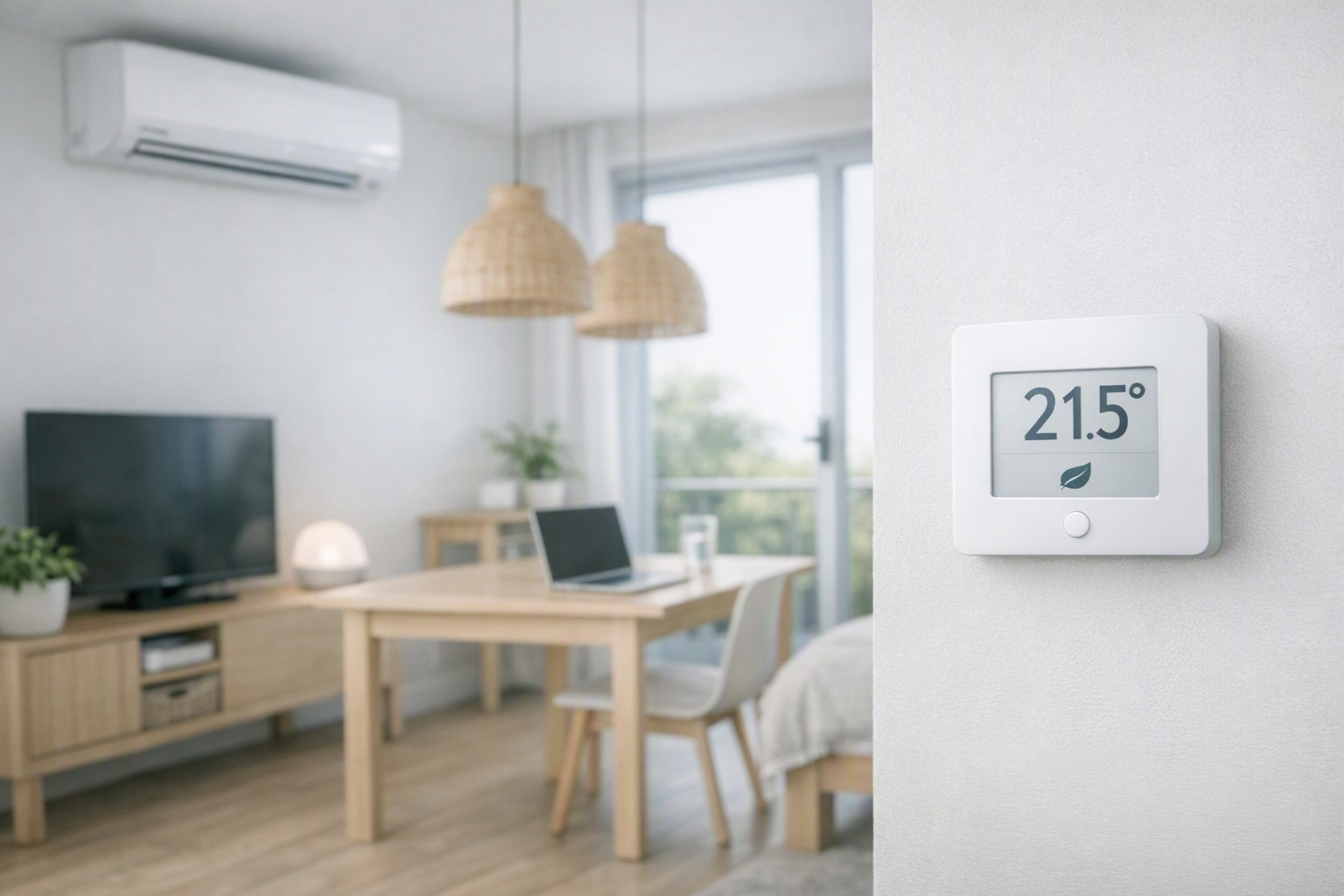
Installing smart thermostats is undoubtedly one of the most profitable investments with the fastest return for any sustainable and profitable accommodation. Devices from brands like Tado, Nest, Ecobee or Honeywell Home offer not only remote control, but a series of advanced functionalities:
- Establish maximum and minimum temperature ranges: This is an essential function. For example, you can limit heating to a maximum of 21°C in winter and air conditioning to a minimum of 24°C in summer. This prevents waste without significantly compromising comfort, as most people feel comfortable within these ranges.
- Remote control and advanced programming: Turn heating and cooling systems off or on from your mobile phone when the accommodation is empty, or schedule them to turn on and off according to guests' check-in and check-out times. You can pre-cool or pre-heat the property a few hours before arrival to ensure a comfortable welcome, and turn it off at checkout.
- Geofencing (Geolocation): Some smart thermostats detect when the guest (via their smartphone and the thermostat app) moves away from the property and automatically reduce climate control intensity or turn it off, reactivating it when they return. This function is especially useful for long stays.
- Humidity and air quality sensors: Some models incorporate sensors that adjust climate control not only based on temperature, but also humidity, improving comfort and efficiency.
- Learning algorithms: The most advanced thermostats learn from guest usage patterns and external weather conditions to optimise operation, anticipating needs and saving energy.
- Voice assistant integration: Allows guests to easily control the temperature using voice commands, improving the experience and reducing the need to touch the physical thermostat.
Window Opening Sensors: A Silent Guardian
It is a very common scenario: guests open windows to ventilate while the air conditioning or heating is running at full power. This is a colossal waste of energy. The solution is simple and effective: installing magnetic window and door opening sensors.
These sensors communicate wirelessly with the property's climate control system. If an external window or door remains open for more than a pre-set period of time (e.g. 2 to 5 minutes), the climate control system turns off automatically. Once the window is closed, the system can resume. This measure, alongside smart thermostats, is fundamental for resource optimisation in holiday rentals and hotels.
Zoning Systems and Preventive Maintenance
- Zoning Systems: In large properties, consider installing zoned heating and cooling systems. This allows you to heat or cool only occupied areas, rather than the entire property. For example, if only the living room and one bedroom are being used, there is no need to heat the other bedrooms or the basement.
- Regular Preventive Maintenance: The efficiency of heating and cooling systems depends heavily on their good condition. Have professional maintenance carried out annually. This includes cleaning filters (something your cleaning team can do regularly), checking refrigerant levels, checking for leaks and ensuring outdoor units are free of obstructions. A poorly maintained system can consume up to 25% more energy.
Automation and Access: The Power of Smart Home Tech Applied to Profitability
Smart home technology not only improves the user experience, offering a modern touch of convenience, but acts as an invisible guardian of your financial resources. Integrating smart access systems allows you to drastically optimise consumption, making your sustainable and profitable accommodation a tangible reality.
Synchronisation of Access and Climate Control with Macufy
This is where property management solutions like Macufy truly shine. By implementing an automated check-in system, you can intelligently coordinate the delivery of virtual keys with the activation of basic services. This way, heating or air conditioning will only be activated a few hours before the guest's estimated arrival, avoiding heating or cooling the house unnecessarily during days of vacancy. Imagine the savings in low occupancy periods or between bookings.
But the intelligence doesn't end there. Electronic lock systems, whether by code, card or smartphone, can be configured to send a signal to the home's smart system at the exact moment of checkout. This allows all lights, appliances and heating/cooling systems to be turned off automatically the moment the last guest leaves, eliminating any chance of human error and guaranteeing maximum energy efficiency in tourist accommodation. This integration is a fundamental pillar for the reduction of operating costs in tourism.
Keycard Switches and Presence Sensors: Consumption Watchdogs
Inspired by the traditional hotel sector, keycard switches or motion sensors in common areas and rooms are powerful tools for consumption management in rental properties. They ensure that electricity only flows when people are physically present in the space.
- Keycard Switches (Energy Savers): Inserting a card (or electronic key) upon entering the room activates the electricity and climate control. Removing the card when leaving turns off all systems or puts them into saving mode. It is a proven and highly effective solution to prevent guests from leaving lights or air conditioning on when they go out.
- Presence and Motion Sensors (PIR): These sensors detect movement and body heat. They are ideal for corridors, bathrooms, kitchens and other areas where occupancy is intermittent. If the sensor does not detect movement for a pre-set period of time (e.g. 30 minutes), it turns off the lights and puts the climate control into saving mode or turns it off. Presence sensors are more sophisticated than motion sensors, as they can detect even tiny movements, avoiding untimely shut-offs.
- Natural Light Sensors (Daylight Harvesting): In areas with plenty of natural light, these sensors adjust the intensity of artificial lighting, or turn it off completely, when there is sufficient daylight.
Complete Smart Home Integration: An Ecosystem of Savings
The real magic of home automation lies in the ability of different systems to communicate with each other. A well-implemented smart home system can:
- Coordinate opening blinds with heating and cooling to optimise sunlight entry and insulation.
- Integrate the security system with lighting to simulate presence when the accommodation is empty.
- Allow centralised control of all devices through a single application, making smart energy management easier for the owner and the cleaning team.
Investing in home automation for holiday rentals not only elevates the standard of your sustainable and profitable accommodation, but also offers a more modern and comfortable guest experience, while protecting your financial resources.
Efficient Lighting: Lighting the Way to Savings and Aesthetics
Although lighting represents a smaller percentage of total consumption compared to heating and cooling, transitioning to efficient systems offers an extremely fast return on investment and is one of the easiest improvements to execute. Furthermore, good lighting contributes enormously to the atmosphere and aesthetics of your efficient holiday property.
Next-Generation LED Technology: Smart and Long-Lasting Light
Replacing all incandescent, halogen or traditional low-energy bulbs with high-efficiency LED technology is the most basic and effective measure. This simple action can reduce electricity consumption for lighting by up to 85%. But the benefits go far beyond energy savings:
- Long Lifespan: LED bulbs have a significantly longer lifespan (up to 50,000 hours, compared to 1,000-2,000 for incandescent ones), which drastically reduces maintenance and replacement costs, a crucial factor in tourist accommodation with high turnover.
- Low Heat Emission: LEDs emit very little heat compared to traditional bulbs, which helps reduce the thermal load on the air conditioning system, especially in summer.
- Versatility and Design: LED technology offers a wide range of options in terms of shapes, sizes, intensities (lumens), colour temperatures (from a warm and cosy white to a cool and modern white) and beam angles. This allows you to create specific atmospheres and highlight decorative elements, improving the guest experience.
- Dimmable: Many LEDs are dimmable, allowing guests to adjust light intensity to their preferences, which, in addition to improving comfort, can contribute to additional energy saving.
- Smart Bulbs: Integrating smart LED bulbs (controllable via app or voice assistant) allows you to create lighting scenes, schedule on and off times, and even change the light colour to adapt the atmosphere to different times of day or moods.
Automation of Transit and Outdoor Areas: Light Only When Needed
In corridors, halls, stairs, bathrooms and outdoor areas, the use of control technology is essential to avoid waste and ensure that light is only on when strictly necessary. This is a key strategy in smart energy management.
- Presence and Motion Detectors: Ideal for corridors, hallways, guest bathrooms and transit areas where lights are often left on by mistake. They turn on automatically when they detect movement and turn off after a period of inactivity. Presence detectors are more sensitive and detect even tiny movements, making them more suitable for bathrooms or kitchens.
- Dusk-to-Dawn Sensors (Photoelectric): Ensure that outdoor lights (gardens, facades, entrances) only turn on when natural light is insufficient, preventing them from remaining active during the day. They are essential for energy saving in outdoor lighting.
- Analogue or Digital Timers: Useful for scheduling decorative, garden or window lights to turn on and off at specific times, for example, at dusk and dawn. Digital timers offer greater flexibility and precision.
- Time-Delay Switches: In stairs or corridors, installing switches that automatically turn off the light after a few minutes can prevent them from being left on by mistake.
By combining LED technology with automation systems, your sustainable and profitable accommodation will not only reduce its electricity bill, but will also offer a modern, comfortable lighting experience adapted to the real needs of guests and the property.
Water Management and Low-Consumption Appliances: Efficiency Beyond Electricity
Efficiency is not limited exclusively to electricity; water consumption and the use of appliances represent crucial expenditure items in any tourist accommodation. Smart consumption management addresses all resources.
Class A Energy Labelled Appliances: The Smart Choice
When renewing appliances such as washing machines, dishwashers, fridges, ovens and tumble dryers, it is essential to opt for those with the best ratings on the European Union's energy labelling scale (classes A, B or C, with A being the most efficient). Although the initial purchase cost is slightly higher, the price difference is quickly amortised thanks to lower water and electricity consumption over their useful life. This is one of the profitable investments in accommodation with a direct impact on your operating costs.
- Understand the New Energy Label: Since March 2021, the EU has simplified the scale to A-G. A current class A is much more efficient than an A+++ on the previous scale. Make sure to check this new classification.
- Eco Functions by Default: Always configure appliances (especially dishwashers and washing machines) to their "Eco" modes by default. These programmes optimise water and energy consumption, even if they take a little longer. Ensure that the accommodation's instruction manual clearly explains how to use them this way and highlights their benefits.
- Appliance Maintenance: Regularly clean washing machine and dishwasher filters. Defrost the fridge periodically if it is not No-Frost, and ensure that door seals are working correctly to prevent cold leaks.
- Fridges and Freezers: Place them away from heat sources and allow good rear ventilation. Adjust the temperature to optimal levels (5°C for the fridge, -18°C for the freezer) to avoid excessive consumption.
- Electric Water Heaters: If you use cylinders, insulate hot water pipes well and consider scheduling their operation to heat water during off-peak electricity hours, if you have an off-peak tariff. Another option, if occupancy allows, is to turn them off between stays.
- Instantaneous (Tankless) Water Heaters: For larger properties or those with high demand, instantaneous water heaters (gas or electric) heat water only when needed, eliminating heat losses from a storage tank.
Water Saving Devices: Small Investments, Big Savings
Water consumption can be reduced by up to 50% through the installation of simple, very cheap accessories that do not compromise guest comfort. These measures are fundamental for sustainable and profitable accommodation.
- Tap Aerators: These small devices screw onto the tap spout and mix air with water. They maintain the sensation of pressure for the user but drastically reduce the water output flow (from 12-15 litres/minute to 4-6 litres/minute), generating significant water saving. They are invisible and highly effective.
- Low-Flow Shower Heads: Limit water flow without harming the comforting shower experience for the guest. Modern models use technologies that optimise water pressure and distribution for a pleasant feeling with fewer litres (going from 15-20 litres/minute to 6-9 litres/minute).
- Dual Flush Systems in Cisterns: Allow the user to choose between two water flush volumes (e.g. 3 or 6 litres), avoiding completely emptying the tank when not necessary. If your toilets do not have this function, you can install conversion kits or opt for low-consumption toilets when renovating.
- Water Leak Detectors: Small leaks in taps, toilets or pipes can go unnoticed and waste thousands of litres of water a year. Install leak detectors or perform regular visual inspections. A dripping tap can waste up to 40 litres a day.
- Pressure Reducers: If the water pressure in your property is excessively high, installing a general pressure reducer can decrease consumption and prolong the useful life of your pipes and appliances.
- Greywater Recycling: For properties with a very high commitment to sustainability, consider systems for treating and reusing greywater (shower, sink water) for flushing toilets or watering gardens. This is an advanced measure, but with a very positive environmental impact.
Integrating these water management solutions and efficient appliances is a fundamental pillar for resource optimisation in holiday rentals and for building sustainable and profitable accommodation at all levels.
The Crucial Role of the Cleaning and Maintenance Team: Guardians of Efficiency
No matter how much technology you implement in your property, the human factor remains decisive. The staff in charge of cleaning and preparing the accommodation are your best allies to guarantee that energy saving and consumption management protocols are strictly followed. Their attention to detail can prevent significant waste.
Establish Strict and Digitalised Departure Protocols
Once guests leave the accommodation, the cleaning team must systematically carry out a series of key energy checks. To ensure that none of these tasks are overlooked, it is highly recommended to use digitalised control forms, such as those offered by Macufy. These checklists allow structured verification of aspects such as:
- Complete shutdown of all lights and lamps on the property: Including decorative lights, bedside lamps and outdoor lights.
- Adjusting thermostats to a maintenance temperature or complete shutdown: During periods of inactivity or between bookings, climate control must be in "off" mode or at a maintenance temperature that prevents damage from extreme cold/heat, without wasting energy.
- Correct closure of all external windows and doors: To prevent temperature loss and ensure security.
- Disconnecting appliances that do not need to be on: Such as TVs, toasters, coffee makers, chargers and, if the property is going to be empty for several days, even the electric water heater.
- Early detection of water leaks: Visually check taps, cisterns, showers and appliances to detect any drips or leaks. A small leak can waste thousands of litres of water a year.
- Checking sockets and power strips: Ensure no connected devices are generating "phantom load".
- Recycling: Empty recycling bins and prepare new ones, ensuring guests have access to clear information on how to recycle.
Digitalising these checklists through a platform like Macufy not only ensures consistency, but also allows real-time tracking and auditing, quickly identifying any non-compliance and providing the opportunity for additional staff training. This is a powerful tool for consumption management in rental properties and for maintaining sustainable and profitable accommodation.
Continuous Training and Awareness
Invest time in training your team on the importance of these practices. Explain the direct impact they have on reducing costs and contributing to sustainability. An aware and well-trained team is much more effective than one that simply follows orders. Run periodic training sessions and encourage feedback to improve protocols.
General Preventive Maintenance
The maintenance team must go beyond reactive repairs. Implementing a regular preventive maintenance plan for all systems and appliances guarantees their efficiency and extends their lifespan. This includes:
- Checking water pressure and the operation of aerators.
- Inspecting window and door seals.
- Cleaning coils in fridges and freezers.
- Verifying thermostat calibration.
Proactive maintenance avoids costly breakdowns and ensures that your efficient holiday property always operates at peak performance.
How to Involve the Guest Without Compromising Their Comfort: The Key of "Nudging"
Guest awareness is a fundamental pillar of sustainability. However, it is vital that guests do not feel that annoying restrictions are being imposed on them that spoil their holiday. The key lies in assertive communication, empathy and the use of "nudging" techniques (gentle nudges that guide behaviour without coercing it).
Friendly Signage and Positive "Nudging"
Instead of placing signs with strict prohibitions that can generate a negative feeling, use positive, informative messages that appeal to collaboration and collective awareness. The objective is to educate and motivate, not scold. Here are some examples:
- Climate Control: "Help us protect the local environment and maintain the beauty of [Region Name]. If you are going out, please remember to turn off the air conditioning or heating. Nature, and your host, will thank you." Or "For an environment that is always fresh and efficient, we recommend keeping the air conditioning at 24°C in summer and the heating at 21°C in winter. Small gestures, big savings!"
- Water and Towels: "In this accommodation, we are committed to sustainability. Responsible use of towels helps us save thousands of litres of water a year and reduce detergent use. If you would like us to change them, please leave them on the floor; if you are going to keep using them, hang them on the towel rail. Thank you for your cooperation!"
- Lights: "Light up your stay smartly! We invite you to turn off the lights when leaving a room or the property. Every small gesture counts for a more sustainable accommodation."
- Recycling: "Help us look after our planet. You will find recycling bins for [plastic, paper, glass] in [location]. Separating is easy and necessary!"
Place these messages strategically: near light switches, in the bathroom, next to the thermostat. The design should be attractive and the tone cordial. You can even include a small fun fact about the energy saving or water savings achieved with each gesture.
Digital Welcome Guide: Your Ecological Ally
Include a section dedicated to the accommodation's ecological practices in your digital (or physical, if you prefer) welcome guide. Explain in simple terms how smart climate control systems work, where the nearest recycling bins are located, and encourage them to join your ecological commitment. This guide can include:
- Clear instructions on using smart thermostats: How to adjust them within pre-set ranges, how to use saving modes.
- Tips for water saving: Shower instead of bath, do not leave the tap running, use dual flush.
- Information on recycling: What is recycled and where.
- Suggestions for sustainable activities in the area: Hiking trails, local markets, public transport.
- The positive impact of their cooperation: Explain how their small gestures contribute to the carbon footprint reduction of the property.
A well-designed and easy-to-read guide transforms the request into an invitation to be part of a positive initiative, reinforcing the image of your sustainable accommodation.
Incentives and Recognition (Optional)
For long-stay guests or groups, you might consider small incentives. For example, a discount card for a local sustainable business if they meet certain goals (measured, for example, by water or electricity consumption, if your system allows it). Public recognition on social media (with their permission) can also be a motivator for green accommodation.
By communicating effectively and positively, you will not only achieve greater commitment from your guests, but you will also reinforce the image of your sustainable and profitable accommodation, attracting that increasingly conscious and responsible segment of travellers.
Renewable Energy and Self-Consumption: The Investment of the Future for Sustainable and Profitable Accommodation
For those owners who wish to take their accommodation's efficiency to the next level and achieve true energy independence, the transition towards clean and renewable energy sources represents the ultimate solution. This is the pinnacle of sustainability strategies for hospitality and holiday rentals, allowing the carbon footprint of tourism activity to be reduced to zero and ensuring sustainable and profitable accommodation in the broadest sense.
Installation of Solar Photovoltaic Panels: Your Own Power Station
Solar photovoltaic energy is one of the most viable, mature and fastest-growing options today. It allows electricity to be generated for free and cleanly during sunny hours, coinciding in many cases with air conditioning consumption peaks in summer. Technology has advanced enormously, making the investment increasingly accessible and profitable.
- Types of Panels: The most common are monocrystalline (higher efficiency in small spaces) and polycrystalline (slightly less efficient but cheaper). For roofs or limited spaces, monocrystalline is usually the best option.
- Grid-Tied Systems: Most self-consumption installations are connected to the electricity grid. This means that when you produce more energy than you consume, the surplus is fed into the grid and can offset part of your electricity bill (simplified compensation mechanism). When you produce less, you draw energy from the grid.
- Battery Storage: To maximise self-consumption and independence, battery storage (such as lithium batteries) can be integrated. These batteries store solar energy generated during the day to be used at night or on cloudy days, further reducing reliance on the grid.
- Viability and Amortisation: Depending on geographical location (sun hours), the size of the installation, available grants (such as European Next Generation funds, regional or municipal aid) and the price of electricity, the payback period for a solar installation typically ranges between 4 and 7 years. Once amortised, the energy you consume is practically free for more than two decades (the lifespan of the panels exceeds 25 years).
- Additional Benefits: In addition to financial savings and carbon footprint reduction, installing solar panels increases your property's value and improves its energy performance certificate, an additional attraction for travellers conscious of sustainability.
Aerothermal Systems: Heating, Cooling and Hot Water from the Air
Aerothermal energy is a clean and highly efficient technology that extracts up to 77% of ambient energy from the outdoor air to produce heating, cooling and domestic hot water (DHW). It is an exceptional alternative to traditional gas or oil boilers and a fundamental pillar for efficient holiday properties.
- How it Works: An aerothermal heat pump works similarly to a fridge, but in reverse. It captures heat from the outdoor air (even at low temperatures) and transfers it indoors for heating or DHW. In summer, the process is reversed for cooling.
- Exceptional Performance (COP): Aerothermal systems have an exceptionally high performance, measured by their Coefficient of Performance (COP). For every kilowatt of electricity consumed to operate, they are capable of generating between 3 and 5 kilowatts of thermal energy. This makes them one of the most efficient alternatives on the market.
- Integration with Other Systems: Aerothermal energy is ideal for combining with underfloor heating systems (which operate at low temperatures), low-temperature radiators or fan coils. It can also be integrated with solar photovoltaic panels, so that the electricity consumed by the heat pump is generated by your own panels, achieving a perfect synergy for self-consumption.
- Advantages: It drastically reduces energy bills, eliminates the need for fossil fuels, emits no CO2 or other pollutants, and is very safe. Furthermore, being an "all-in-one" system (heating, cooling, DHW), it simplifies installations.
Other Renewable Energies to Consider
- Solar Thermal: Uses panels to heat water directly, ideal for covering a large part of domestic hot water needs. It can be complemented with aerothermal energy or electric water heaters.
- Geothermal: Although the initial investment is higher, it takes advantage of the constant ground temperature for heating, cooling and DHW, offering even higher efficiency than aerothermal energy under some conditions. It is an option for properties with a high commitment and budget.
Investing in renewable energy in tourism is a strategic decision that not only protects you from energy price volatility, but positions your sustainable and profitable accommodation at the forefront of the sector, attracting a premium and conscious market segment.
Conclusion: A Profitable and Responsible Path Towards the Future of Tourism
The transformation of the tourism sector is an undeniable reality. Profitable investments in accommodation are no longer measured solely by short-term financial return, but also by environmental impact and the ability to adapt to a constantly evolving market. Optimising resource consumption in your tourist property is not just a passing trend, but an imperative need to guarantee the economic viability of your business in the medium and long term.
Through the smart combination of strategies – from detailed initial audits, the implementation of smart climate control and home automation for holiday rentals, to cleaning staff awareness and training, and proactive guest involvement – it is possible to reduce utility operating costs by between 20% and 50%. These figures are not mere estimates; they are tangible results that translate directly into an increase in your profit margin.
Beyond financial savings, by taking the step towards sustainability, you will not only be protecting your profit margins against energy market volatility, but you will also be positioning your accommodation as a preferred choice for an increasingly conscious, responsible market of travellers willing to value commitment to the care of our planet. A sustainable and profitable accommodation attracts more loyal guests, improves your online reputation and differentiates you from the competition.
Integrating solutions for consumption management and energy efficiency in tourist accommodation, together with smart management tools like those offered by Macufy, will allow you to not only achieve the desired profitability, but also actively contribute to a greener and more responsible tourism future. The time to act is now. Your business, your guests and the planet will thank you. Start building sustainable and profitable accommodation today!