
Contactless Check-In: The Ultimate Guide to Automating Your Holiday Rental
The Paradigm Shift in the Tourism and Holiday Rental Sector
The tourist accommodation industry has undergone an unprecedented transformation in recent years. What was once considered a luxury service or a purely technological option for a select few is now a market demand. Contemporary travellers value flexibility, immediacy, and convenience above almost everything else. In this scenario, traditional reception based on rigid schedules and unnecessary waiting is giving way to a much more efficient model adapted to modern times.
The rise of holiday rental platforms has empowered guests, who now seek seamless experiences from the very moment they make their booking. For property owners and managers, this evolution represents both a challenge and a golden opportunity. Those who manage to adapt and digitalise their processes not only succeed in optimising their daily operations, but also experience a notable increase in customer satisfaction and, consequently, in the profitability of their businesses.
From Traditional Reception to Digital Autonomy
For decades, the arrival process at tourist accommodation involved meticulous coordination between the host and the guest. Flight delays, unexpected traffic, or lost phone connections often translated into hours of frustrating waiting for both parties. This analogue model not only consumed a huge amount of time and resources but also generated an unnecessary point of friction right at the start of the stay.
Digitalisation has resolved this problem at its roots. By transferring access control to the guest themselves through virtual systems, the need to physically meet for key handover is eliminated. This paradigm shift does not mean losing the human touch; on the contrary, it frees hosts from mechanical and repetitive tasks so they can focus on offering higher quality, personalised hospitality with true added value.
What Exactly Is Contactless Check-In?
Contactless check-in (also known as self-check-in or autonomous entry) is a method that allows guests to access tourist accommodation completely independently, without the need to physically interact with the owner, manager, or reception staff. The entire process, from identity verification to unlocking the front door, is carried out digitally and automatically.
This system relies on a combination of software tools and physical hardware devices. Through a centralised management platform, the owner can coordinate the legal registration of travellers, the signing of the short-term tenancy agreement, and the generation of temporary access credentials that will only be valid during the specific dates and times of the booked stay.
Key Differences Between In-Person and Digital Registration
To understand the real impact of this technology, it is essential to contrast the workflow of both methods:
- In-Person Registration: Requires the physical presence of the host or an employee at the property. It depends on the guest's punctuality, limits arrival times (penalising late-night check-ins), and requires manual completion of paper guest registration forms for subsequent submission to the authorities.
- Digital and Self-Check-In: The guest completes their identity details from their own mobile device before travelling. Access credentials (numerical codes or virtual keys) are sent automatically once registration is verified. Access is gained independently at any time of the day or night, and legal data is instantly transmitted to law enforcement authorities.
How the Self-Check-In Process Works Step-by-Step
Implementing a remote access system is not simply about placing a key safe on the building's facade. For it to be a secure, legal, and truly satisfactory process, it must follow a logical and well-coordinated structure that guarantees peace of mind for both parties. Below, we break down the fundamental phases of this digital workflow.
1. Booking Confirmation and Pre-Registration
The process begins the very moment the booking is confirmed, whether through direct channels or OTAs like Airbnb, Booking.com, or Vrbo. Immediately, the system sends a welcome message to the guest with a personalised link to their pre-registration portal. In this virtual space, the customer can enter their personal details, upload a photo of their identity document (ID card or passport), and complete a biometric validation process to confirm that their face matches the image on the document.
2. Identity Verification and Legal Compliance
In countries like Spain, current regulations oblige tourist accommodation owners to register the identity of all guests over the age of 14 and report this data to the police within a maximum of 24 hours of arrival. With an automated check-in system, this task stops being a manual headache. The platform processes the information securely, generates the corresponding guest registration forms, and automatically sends them to official platforms such as SES.HOSPEDAJES, the Guardia Civil, or the National Police, guaranteeing strict compliance with Royal Decree 933/2021 without the owner having to intervene manually for each booking.
3. Sending Instructions and Access Codes
Once the legal registration is successfully completed and the booking payment (as well as the security deposit, if applicable) is verified, the system activates the access credentials. The best way to manage this step is through the use of automated messages to guests. Through direct communication channels such as WhatsApp, SMS, or email, the guest receives a clear and detailed message with arrival instructions, the exact location of the property, local recommendations, and, of course, their unique access code or digital opening link.
4. Physical Entry into the Accommodation
Upon arriving at the property, the guest does not have to worry about the time. They simply enter the numerical code received on the smart lock keypad or press a button on their mobile screen to unlock the door. This process takes just a few seconds, is extremely intuitive, and completely eliminates the anxiety associated with travel delays or lost physical keys.
5. Simplified Check-Out Process
At the end of the stay, the reverse process is just as simple. The guest only has to close the door behind them. The system automatically detects that the stay has ended, immediately revokes the validity of the access code to guarantee the security of the property, and can send an automatic thank-you message, requesting a review on the booking platforms and inviting the customer to return in the future.
Essential Technologies to Implement Contactless Check-In
To build a robust and reliable self-check-in ecosystem, it is necessary to select the right technological tools. Fortunately, today's market offers highly mature hardware and software solutions that adapt to any type of property, from a city-centre apartment to an isolated countryside cottage.
Smart Locks
The smart lock is the physical heart of the self-check-in system. These devices replace or fit over the traditional door cylinder and allow electronic locking and unlocking of the closing mechanism. There are different types depending on the needs of the accommodation:
Keypad Smart Locks
These are, by far, one of the most popular and recommended options for holiday rentals. They do not require the guest to install any application on their mobile phone, nor do they need an internet connection or active Bluetooth at the time of arrival. The owner generates a 4 to 6-digit code linked to the booking dates; the guest only has to type it into the lock to enter. It is a universal system, accessible to people of all ages, and extremely reliable.
App or Bluetooth-Enabled Locks
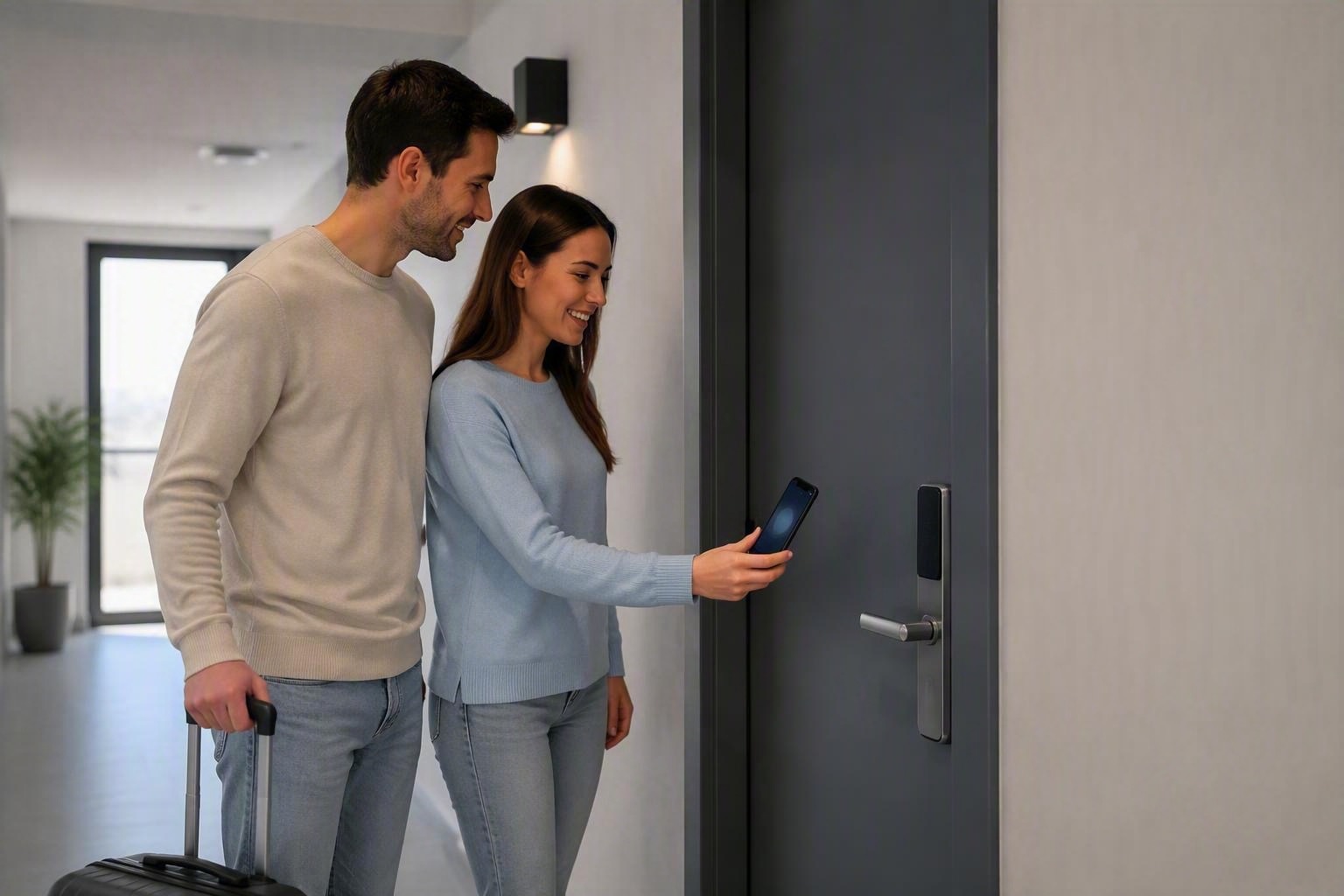
These locks allow the guest to unlock the door using their own smartphone. When approaching the lock, the dedicated mobile app (or a secure web link) detects the device using Bluetooth or Wi-Fi technology and allows it to be opened with a single tap on the screen. It is a highly modern and secure solution, although it requires the guest to have battery life on their phone and be familiar with using mobile apps.
Smart Key Safes (Smart Keyboxes)
If the building management rules or the structure of the main door do not allow for a smart lock to be installed directly, smart key safes are the perfect alternative. These devices are anchored to the exterior wall or a firm surface and store the physical keys inside. The guest enters a digital code previously sent by the host to open the box and retrieve the keys. At the end of the stay, they place them back inside.
Payment Gateways and Digital Identity Verification
Security is not limited to physical access; it also covers financial and legal validation. Digital identity verification tools use artificial intelligence algorithms to scan identity documents from over 150 countries, verify their authenticity, and compare them with a real-time selfie of the user. This drastically prevents identity theft fraud and ensures that the person accessing the property is exactly the same person who made the booking.
Property Management Systems (PMS)
There is no point in having the best smart lock on the market if the owner has to manually generate each access code and email it to each customer. This is where property management software (PMS) like Macufy becomes vital. The PMS acts as the brain of the business, connecting smart locks, booking channels (Airbnb, Booking, etc.), automated communication systems, and legal registration tools in a single, unified control panel.
Competitive Advantages for Property Owners and Managers
Adopting a remote access system is not just a convenience measure for the guest; it is a strategic decision that radically transforms the operational efficiency and profitability of the holiday rental business.
Time Optimisation and Reduction of Operating Costs
The most valuable resource for any host or property manager is time. Physical key handover consumes hours of travel, unproductive waiting, and constant telephone coordination. By automating this process, these inefficiencies are instantly eliminated. A single manager can centrally administer dozens of properties distributed across the country from their computer or mobile phone, drastically reducing staffing and logistical costs.
Absolute Flexibility and Eliminating Waiting Times
Travel disruptions are inevitable. A flight delayed by weather conditions or a traffic jam on the motorway can delay the guest's arrival by several hours. Under the traditional system, this forced the host to wait until the early hours of the morning or charge surcharges for "late check-in" (which usually causes annoyance for the customer). With self-check-in, the guest can arrive at 3:00 AM without causing the slightest inconvenience to the owner, ensuring a stress-free arrival with total flexibility.
Greater Security for the Property and Guests
Traditional physical keys pose serious security risks: they can be lost, stolen, or worse, copied without authorisation by previous guests or passing staff. With digital access systems, physical keys disappear. Access codes are temporary and are automatically destroyed at the exact moment of check-out. In addition, the owner has a real-time activity log detailing exactly who has entered and left the property (guests, cleaning staff, maintenance, etc.), providing unprecedented peace of mind and control.
Higher Ratings and Better Positioning on OTAs
The algorithms of platforms like Airbnb and Booking.com highly reward accommodations that facilitate self-check-in, highlighting them in the search filters preferred by business travellers and families. Furthermore, a smooth, fast, and hassle-free arrival experience is the first step towards obtaining a 5-star rating. Positive reviews attract new guests, naturally increasing occupancy and the average nightly rate of the accommodation.
Direct Benefits for the Guest Experience
The customer experience in the tourism sector begins long before they cross the threshold of the accommodation. The arrival process sets the tone for the entire stay. Offering modern and independent access directly influences the overall perception of the service received.
Zero Stress over Travel Delays
Travelling can be an exhausting and stressful activity. The last thing a guest wants after a long car journey or a transatlantic flight is to have to adhere to a strict appointment time to receive keys, or feel guilty about keeping their host waiting due to a delay beyond their control. Knowing that their access code will be waiting for them at any time completely eliminates this source of anxiety, allowing them to enjoy the trip at their own pace.
Privacy and Independence from the Very First Minute
Many travellers, especially families, couples, or those travelling for work, highly value their privacy. Self-check-in allows them to settle into the accommodation privately, without the need to engage in polite small talk or go through a formal registration process when they are tired. This generates a pleasant feeling of home and belonging from the very first moment.
Clear and Fluid Communication
Process automation does not mean neglecting the customer. On the contrary, by digitalising data registration and physical access, much clearer and more efficient communication channels are structured. The guest has all the relevant information in writing on their mobile phone, which reduces language misunderstandings or doubts about how appliances work, house rules, or the Wi-Fi password.
Common Myths About Remote Check-In
Despite the evidence of its multiple benefits, some prejudices and false beliefs still exist among certain traditional owners who resist making the digital leap. Let's analyse and debunk the most common myths in the sector.
Myth 1: "It makes the service cold and impersonal"
False. Hospitality is not measured by handing over a piece of metal in person. A rushed traditional check-in, where the host is in a hurry to leave for another handover, is often much more impersonal than a flawless digital process backed by warm, attentive, and constant communication through digital channels. By freeing themselves from the operational burden of physical handovers, the host has more time to interact qualitatively with the guest, recommending personalised local restaurants, resolving queries in real time, or preparing welcome details at the property.
Myth 2: "It is insecure and facilitates fraud"
False. It is exactly the opposite. Metal keys are the weakest link in residential security, as anyone can copy them in a few minutes. Conversely, digital credentials are encrypted, single-use, and expire automatically. Furthermore, modern digital identity verification systems are infinitely more accurate at detecting forged passports or ID cards than the human eye of a tired host in a poorly lit late-night reception.
Myth 3: "The technology is too complicated for older guests"
False. The user interfaces of today's systems are designed under strict usability and accessibility criteria. Entering a numerical code on a touchscreen keypad located on the door handle is a process identical to using a cash machine or unlocking a mobile phone, something with which the vast majority of the population of all ages is fully familiar. In addition, you can always maintain a backup telephone support channel to resolve any specific queries in seconds.
How to Implement Contactless Check-In with Macufy
If you have decided to take the step to modernise your holiday let business, Macufy is the perfect technological ally to achieve this simply, seamlessly, and without technical complications. Our platform has been specifically designed to meet the real needs of property owners and managers looking to automate their daily processes without losing control of their activity.
Configuring Automated Workflows
With Macufy, you can design a fully customised digital workflow that adapts to the style of your accommodation. From the control panel, you configure the rules so that the system automatically sends pre-registration links as soon as a booking comes in from any sales channel. You can set automatic reminders if the guest forgets to complete their details before the arrival date, ensuring that all documentation is ready and verified in advance.
Integration with Locks and Access Systems
Our platform integrates bi-directionally with the market's leading smart lock and key safe manufacturers. This means that once the guest has successfully completed their identity registration and signed the rental agreement, Macufy communicates directly with the lock installed at your property to generate the temporary access code. The system links this code to the arrival and departure dates and times of the booking and communicates it to the guest fully autonomously, without you having to perform any manual action.
Automating Guest Registration Submissions
Forget about filling in tedious forms by hand or having to connect to the police website every night to register your guests. Macufy automatically extracts the information collected during digital pre-registration, generates the files in the official formats required by Royal Decree 933/2021, and securely transmits them to the relevant databases of the public authorities. All this is done transparently, guaranteeing strict regulatory compliance and protecting your business against potential administrative penalties, which can be very high.
Conclusion: The Future of Holiday Accommodation Management
Contactless check-in has ceased to be a future option and has become an imperative necessity of the present. Owners who continue to cling to traditional physical reception methods are not only incurring unnecessary operating costs and losing invaluable management time, but also risk falling behind competitors who offer an infinitely more convenient, agile user experience adapted to the expectations of the 21st-century traveller.
Automating access and legal registration does not dehumanise the service; on the contrary, it is the tool that allows the true essence of hospitality to be recovered: quality care, personalisation, and the creation of memorable experiences. By delegating repetitive, bureaucratic, and mechanical tasks to a robust and specialised platform like Macufy, you regain the freedom to focus on what truly matters: growing your business, improving your reviews, and maximising the profitability of your tourist properties.