
Comprehensive Guide to Automating WhatsApp in Holiday Accommodation: Access Delivery, Rules, and Continuous Support
The Transformation of Guest Communication in Holiday Rentals
The short-term holiday rental and boutique accommodation sector is undergoing a radical transformation driven by the expectations of the digital traveller. Traditionally, property owners and managers have relied heavily on email and inbox messaging from major online travel agencies (OTAs). However, the saturation of these channels has led to a dramatic drop in engagement rates.
While a commercial or informative email typically sees open rates between 15% and 25%, WhatsApp consistently achieves open rates exceeding 95%, with the vast majority of messages read within the first three minutes of delivery. For a host, this difference is not merely a marketing statistic, but the fine line between a seamless check-in and a midnight emergency call because a guest cannot find the property keys.
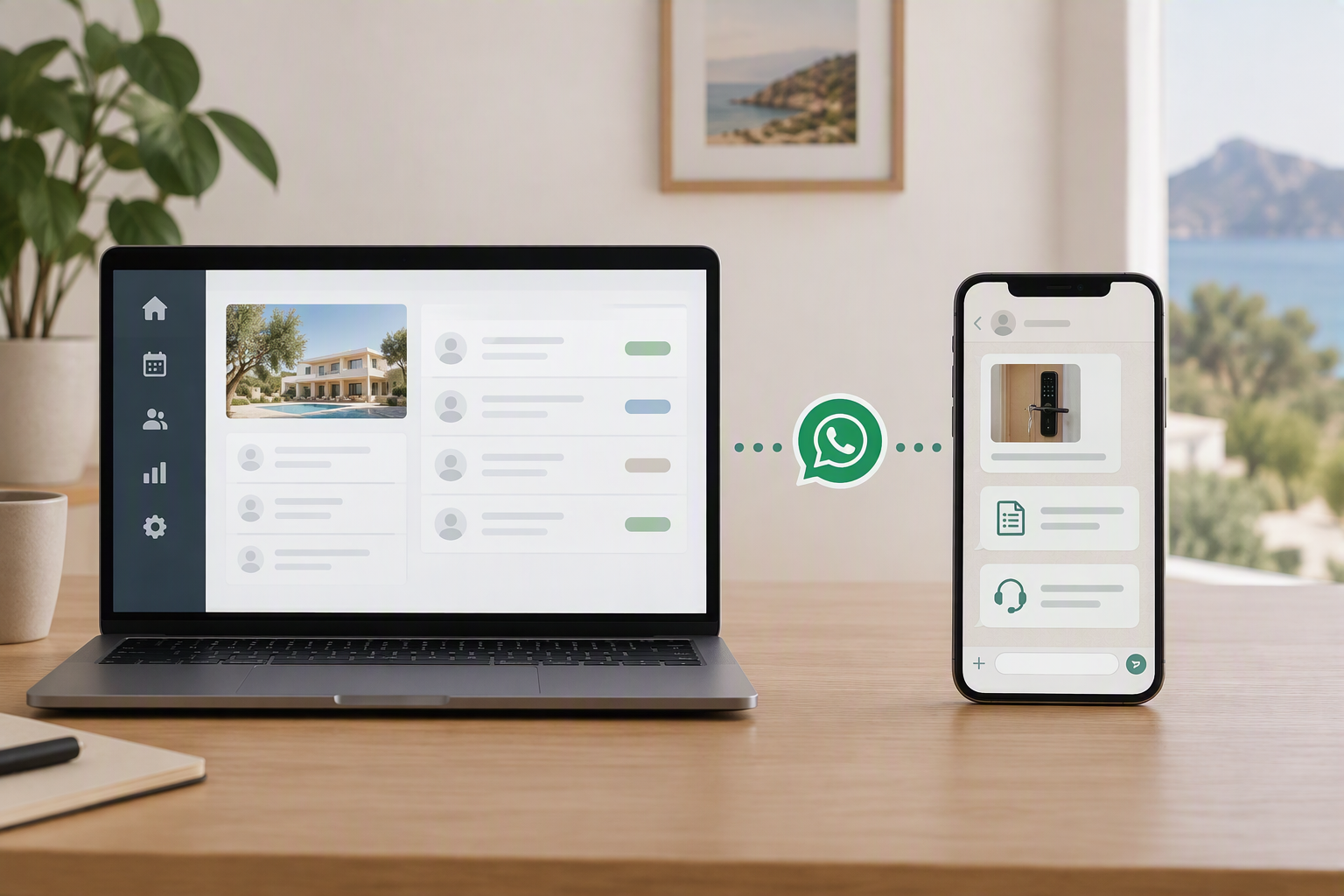
Integrating this direct channel systematically and automatically helps resolve recurring logistical issues, speeds up the delivery of access codes, and enhances the property's reputation. Throughout this technical and strategic guide, we will analyse how to structure an automated messaging architecture aimed at optimising every interaction, complying with current regulations, and guaranteeing a five-star personalised experience.
Why WhatsApp Outperforms Email and OTA Messaging Platforms
Platforms such as Airbnb or Booking.com offer their own internal messaging systems. While useful during the initial booking phase, they present significant operational limitations once the guest is in transit:
- Dependence on constant connectivity and heavy apps: Many international travellers disable mobile data roaming or lack the booking apps installed, relying instead on sporadic public Wi-Fi networks.
- Spam filters and link blocking: External platforms frequently hide or block essential links, such as instruction manuals in PDF format, Google Maps locations, or direct links to payment gateways and identity verification systems.
- Inboxes cluttered with transactional emails: Booking confirmations are easily buried among bank notifications, flight booking alerts, and promotional emails.
Faced with these obstacles, instant messaging via mobile phone number offers immediacy, low data usage, and a universally familiar interface. Guests do not need to learn how to navigate new software; they receive critical information directly within the app they already check dozens of times a day to chat with family and friends.
Technical Architecture: Personal WhatsApp vs. Business vs. WhatsApp Business API
Before implementing any automation flow, it is essential to understand the functional and regulatory differences between Meta's three messaging platform options:
Personal WhatsApp
Designed exclusively for private conversations between individuals. It lacks quick reply tools, catalogues, labels, or third-party software integrations. Using it for systematic commercial activity violates Meta's Terms of Service and exposes the host to a permanent phone number ban.
WhatsApp Business App
A free application tailored for small local businesses. It allows you to set up a business profile with opening hours, basic welcome and away messages, and manual tags to categorize clients. While a useful stepping stone for managers with one or two properties, it does not allow true automation based on calendar events, nor does it integrate natively with dynamic databases.
WhatsApp Business API / Cloud API
The ultimate enterprise infrastructure. It allows you to link your communication channel with Property Management Systems (PMS), booking engines, and automation tools. Through this application programming interface, messages can be triggered based on specific time events (for example: exactly 4 hours before scheduled check-in time) using dynamic variables such as the guest's name, smart lock passcode, or Wi-Fi key.
Planning the Communication Flow Across the Guest Life Cycle
Successful automation is not about bombarding the guest with constant notifications, but delivering the exact piece of information at the precise moment it becomes relevant. Below, we break down the five cardinal phases of the user journey:
Phase 1: Booking Confirmation and Legal Identity Verification
Immediately after a booking is confirmed, the primary objective is to set expectations, offer peace of mind, and collect the formal guest data required by local tourism legislation. At this critical stage, gathering guest registration details often becomes an administrative bottleneck if handled manually.
To streamline this process, many experienced operators combine the initial welcome message with a link to an automated check-in system. In this way, guests complete their registration autonomously on their mobile devices before arriving, ensuring compliance with legal guest registration laws without burdening the operations team.
Phase 2: Countdown and Access Logistics
Approximately 24 to 48 hours prior to arrival, guest stress levels increase if access instructions are unclear. This is the ideal moment to supply operational arrival details.
- Exact location and visual references: A geotargeted link for Google Maps or Waze, accompanied by details regarding entrance gates, building staircases, or prominent landmarks.
- Keyless entry instructions and dynamic codes: If smart locks or key safes are used, the code should be sent in good time, with active access restricted strictly to the duration of the booking.
- Parking policies: Information on whether assigned parking spaces require a remote control, maximum vehicle height limits, or recommended public parking nearby.
Phase 3: Welcome, House Rules, and Proactive Support
Once door sensors register entry or a reasonable time has elapsed after official check-in, a contextual welcome message reinforces a feeling of attentive care. Rather than forcing guests to flick through a 100-page physical binder on the living room table, providing a concise interactive index with key information is far more effective:
- Wi-Fi network name and exact password (in plain text, easily copied with a single tap).
- Location of the main circuit breaker and water stopcocks in case of domestic emergencies.
- Specific guidelines regarding waste management, nearby rubbish bins, and municipal recycling schedules.
- Strict house rules regarding quiet hours, use of communal areas, or an explicit ban on parties.
By managing this workflow through systems tailored for automated guest messaging, property managers dramatically cut down redundant enquiries and ensure all critical information remains documented in the chat thread.
Phase 4: Real-Time In-Stay Support
During the stay, the goal is to provide helpful assistance without being intrusive. A great practice is scheduling a short message the morning after the first night, politely asking if the room temperature was comfortable and if they slept well. This simple gesture makes it possible to detect minor issues (such as a faulty coffee machine or a request for extra towels) before they turn into a negative public review.
Phase 5: Simplified Check-out and Review Generation
On the eve of departure, the automated flow should remind guests of the check-out deadline, heating/air conditioning shutdown procedures, key return instructions, and waste disposal points. Following final departure and initial house inspection, the cycle concludes by requesting an honest review, offering a direct link to the property profile on Google Maps or the original OTA platform.
Production-Ready Message Templates: Real-World Use Cases
Below are battle-tested message templates designed to maximise readability and response rates on WhatsApp, using dynamic personalization tags compatible with property management platforms:
Template A: Confirmation and Online Identity Registration
Hello, {{guest_name}}! A warm welcome to {{accommodation_name}}. We are delighted to host you for your stay from {{checkin_date}} to {{checkout_date}}.
To ensure a swift check-in on arrival and fulfill local legal registration requirements, please complete the online guest form via this official link: {{digital_checkin_link}}.
If you need to arrange any details in advance, feel free to reply directly to this message. Safe travels!
Template B: Secure Access Delivery (Day of Arrival)
Hello again, {{guest_name}}. Your accommodation is fully prepared for your arrival.
📍 Exact location: {{maps_link}}
🔑 Entry instructions: On the main door keypad, enter your temporary code: #{{access_code}}*
📡 Apartment Wi-Fi: Network: {{wifi_ssid}} | Password: {{wifi_password}}
Please confirm receipt of this message once you enter the property so we know everything meets your expectations.
Template C: Quality Check After the First Night
Good morning, {{guest_name}}. We hope you enjoyed a restful night's sleep at {{accommodation_name}}.
We are just checking in to ensure everything is working smoothly (hot water, climate control, and amenities). Should you need extra towels or have questions about appliances, reply here and our team will be glad to assist.
Template D: Check-Out Reminder and Final Guidelines
Dear {{guest_name}}, we hope your stay has been wonderful. As a reminder, check-out is scheduled for tomorrow before {{checkout_time}}.
Before departing, we kindly ask you to:
• Switch off lights and air conditioning/heating units.
• Leave the keys in {{key_instructions}}.
• Dispose of rubbish bags in the outdoor bins.
Thank you very much for taking great care of our property!
Advanced Segmentation and Dynamic Tagging Strategies
Automated communication should never feel cold or generic. When configuring connections between your property manager software and the messaging API, establish logical rules to tailor content based on guest profiles:
Segmentation by Guest Language
Detecting the guest's international dialling prefix (+44, +34, +33, +49) or selected booking language allows your system to deliver templates in their native tongue automatically. Guest satisfaction improves significantly when technical house guidelines are understood effortlessly without language barriers.
Corporate vs. Leisure Guest Tailoring
The requirements of a corporate traveller differ drastically from those of a family on holiday. While business travellers prioritise Wi-Fi speed, VAT invoices, and contactless late check-in, a family will appreciate recommendations for nearby supermarkets, pharmacies, or safety warnings regarding balcony doors or stair gates.
Legal Compliance: GDPR in Instant Messaging
Sending operational or marketing messages via WhatsApp requires strict compliance with European privacy regulations, specifically the General Data Protection Regulation (GDPR) and ePrivacy directives:
- Explicit Consent (Opt-In): A guest's phone number must not be used for purposes other than operational stay management unless explicit consent for marketing communications has been granted via an opt-in checkbox.
- Transactional vs. Marketing Messages: Check-in details, emergency notices, or house rules fall under contractual performance. However, sending promotional offers or restaurant recommendations tied to affiliate commissions requires prior explicit opt-in.
- Opt-Out Options: Corporate communications must clearly indicate that recipients can opt out or request a switch to an alternative channel (such as email) at any time.
- Secure Metadata Handling: Avoid sharing sensitive personal documents (unencrypted copies of passports or IDs) through unprotected chats. Industry-standard management platforms route these processes through encrypted web forms hosted on secure European servers.
Handling Incidents: Smooth Escalation from Bots to Human Teams
Despite the power of automated workflows, hospitality cannot rely solely on algorithms. The success of an automated ecosystem lies in its ability to route conversations seamlessly to a live operator whenever complex situations arise.
To avoid guest frustration caused by limited virtual assistants, apply these operational guidelines:
Alarm Keyword Detection
If a guest types urgent terms such as "water leak", "broken lock", "police", "urgent", or "accident", the automated sequence must pause immediately, triggering an urgent alert to the duty manager's phone for immediate human intervention.
Setting Clear Expectations for After-Hours
Set up automated courtesy replies during off-peak hours: "Our team is currently off-duty (standard support hours: 08:00 to 22:00). We have received your message and will respond first thing in the morning. If this is an urgent maintenance emergency, please tap this link to call our duty line: ...". This manages expectations and maintains clear boundaries without compromising guest safety.
Common Pitfalls to Avoid in Message Automation
Many hosts make technical errors when setting up automation for the first time. Pay attention to the following common missteps to protect your brand image:
- Sending Walls of Text: WhatsApp is a rapid, visual medium. A ten-paragraph message without line breaks or bullet points is difficult to digest on a mobile screen. Use bold text, short bullet points, and clear emojis to structure information cleanly.
- Triggering Messages at Inappropriate Hours: If a guest books at 3 AM, an instant automated confirmation chime could wake them up and cause frustration. Use buffer windows for non-urgent messages.
- Ignoring Previous Guest Context: Sending physical key pickup instructions when a property features digital door keypads displays a lack of attention to detail and creates unnecessary confusion.
- Failing to Test Dynamic Links: A broken link returning a 404 error when opening an arrival map can instantly ruin a guest's first impression.
The Impact of Seamless Messaging on Reviews and Profitability
Adopting direct messaging channels yields a clear, measurable return on investment for short-term rental businesses. Industry research highlights strong correlations across several metrics:
Reduced Operational Support Costs
By proactively answering up to 80% of routine questions (Wi-Fi password, thermostat operation, waste disposal, kitchen appliances), support teams or individual hosts drastically reduce minor phone calls, freeing up valuable time for marketing and property upgrades.
Higher 5-Star Review Rates
The majority of 3 or 4-star reviews on platforms like Airbnb, Vrbo, or Booking.com stem not from structural property defects, but from check-in friction or feeling unsupported during minor issues. Guests supported promptly demonstrate far greater goodwill and are much more likely to leave glowing 5-star reviews.
Conclusions: Balancing Efficiency with Genuine Hospitality
Automating WhatsApp does not mean removing the personal touch; on the contrary, it saves valuable time that can be reinvested where it truly matters: delivering exceptional hospitality and personal care. By building well-structured communication workflows, hosts ensure every guest feels supported, informed, and confident throughout their stay, elevating the overall guest experience to a superior competitive standard.