
Strategies to increase direct bookings on your tourist accommodation website
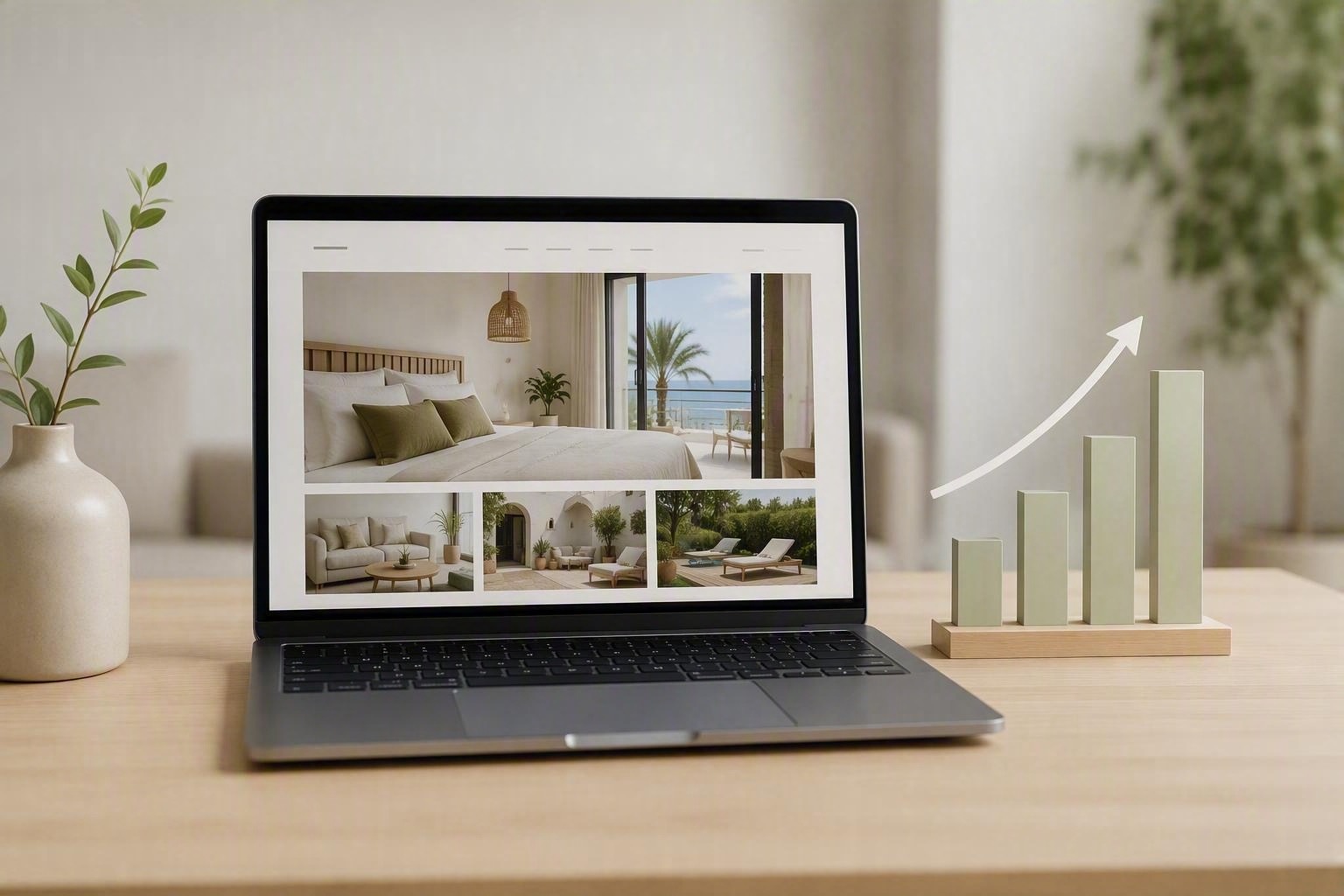
The paradigm shift: Why rely less on OTAs and focus on direct bookings?
For years, Online Travel Agencies (OTAs) such as Booking.com, Airbnb or Expedia have been the predominant distribution channels for the tourist accommodation sector. Whilst these platforms offer unrivalled global visibility, they also entail significant costs that eat into the profit margins of property owners and accommodation managers. Booking commissions, which typically range between 15% and 25%, represent a substantial operating expense that could be transformed into net profit.
Opting for a direct sales channel does not mean turning your back on OTAs, but rather balancing the scales. It is about implementing a mixed distribution strategy where your own website acts as the most profitable and persuasive channel. By diverting a percentage of your bookings to your website, you not only save on commissions, but you also gain full control over the customer relationship, obtain valuable first-hand data and build a solid brand for the long term.
To achieve this goal, it is necessary to transform your website from a simple digital brochure into a highly optimised conversion engine. This requires a combination of three fundamental pillars: organic positioning (SEO) to attract qualified traffic, user experience (UX) design to prevent abandonment during the purchasing process, and process automation to offer professional and frictionless management.
SEO optimisation for tourist accommodation websites: How to attract qualified traffic
Search engine positioning is the foundation upon which any direct acquisition strategy is built. If your accommodation does not appear on the first pages of Google when a user searches for options in your destination, you simply do not exist to them. To compete with the giants of the sector, the key is not to bid on high-volume generic terms, but to dominate niche searches and local purchase intent.
Keyword Research focused on conversion
Many owners make the mistake of optimising their website solely for highly competitive terms like "hotel in Madrid" or "holiday apartment in Malaga". Competing against Booking for these keywords requires millionaire budgets. Instead, the smart strategy is to target long-tail keywords and searches with a clear transactional intent.
To identify these opportunities, you must analyse the unique attributes of your property and the specific needs of your target audience. Consider semantic variations and combinations that include:
- Specific location or points of interest: "holiday apartment near the Sagrada Familia", "country house with pool in Sierra de Gredos".
- Target audience or type of trip: "pet-friendly accommodation in Asturias", "luxury villas for families in Marbella".
- Exclusive features and services: "boutique hotel with private hot tub in the room", "tourist apartment with free parking and fast Wi-Fi".
By optimising your pages for these more specific queries, you will attract users who are at an advanced stage of the buying decision funnel, resulting in a significantly higher conversion rate.
Local SEO: The treasure map to attract travellers
For accommodation businesses, local SEO is a critical acquisition channel. Google prominently displays the local map (Local Pack) for the vast majority of lodging-related searches. To position yourself here, it is essential to optimise your Google Business Profile (formerly Google My Business).
Ensure that all information on your profile is accurate, consistent and up to date. Use the same name, address and phone number (NAP data) that appear on your website. Upload high-quality images of the rooms, common areas and exteriors. Furthermore, actively encourage your guests to leave positive reviews; the quantity, quality and frequency of reviews are decisive ranking factors for Google.
On-Page SEO: Website architecture and technical optimisation
The technical structure of your website must facilitate both search engine crawling and user navigation. Each type of accommodation or room must have its own optimised landing page. This allows the content to be structured in a hierarchical and relevant manner.
Some crucial technical aspects that you should audit and improve include:
- Title tags and meta descriptions: They must be appealing, include the main keyword and respect character limits to avoid being truncated in search results.
- Heading structure (H2, H3, H4): Organise the content logically. Use H2s for main sections and H3s to break down specific details of services or location.
- Image optimisation: Tourist accommodations rely heavily on visuals. However, heavy images slow down the website. Compress photos using modern formats like WebP and do not forget to add descriptive alternative texts (alt text) that include keywords naturally.
- Loading speed (Core Web Vitals): A delay of just a few seconds in loading your website can cause a potential customer to return to the search results. Optimise the code, use quality hosting and leverage caching.
Content marketing: Providing value beyond accommodation
An active blog within your website is an excellent tool for capturing traffic during the informational phases of the trip. Tourists do not just look for a place to sleep; they also research what to do, where to eat and how to get around the destination. By creating detailed local guides, recommendations for hidden-gem restaurants or three-day travel itineraries, you position your brand as a trusted local authority.
When a traveller reads your guide on "The best restaurants for traditional food in Segovia" and discovers that you offer a cosy apartment just a few metres from the aqueduct, the probability of them booking directly with you increases exponentially.
User Experience (UX) optimisation on your website
Attracting visitors to your website is only half the job; the real magic happens when you convert those visitors into confirmed guests. A poor user experience, an outdated design or a complex booking process will destroy your SEO efforts. The UX must be designed to guide the user by the hand towards the booking button.
The 3-click booking process: Eliminate friction
Simplicity is the key to online conversion. If a user has to fill out endless forms, create a mandatory account or wait for you to reply to an email to check availability, they will abandon your website and book on an OTA that offers immediate confirmation. Your booking engine must be visible from the very first second of browsing, preferably via a persistent date search bar at the top of the screen.
The ideal booking flow should consist of three simple steps:
- Selection of dates and number of guests: With a clear display of prices and real-time availability.
- Room or rate selection: Transparently showing what each option includes and the cancellation policies.
- Simplified payment form: Requesting only the data strictly necessary to process the transaction securely.
"Mobile-First" design: Built for the touchscreen
More than 60% of travel searches and an increasing percentage of final bookings are made from mobile devices. Your website must not only be responsive, but it must be designed with the mobile user in mind first. This means that buttons must be large enough to be tapped with a thumb, texts must be legible without the need to zoom, and the checkout process must be compatible with modern methods like Apple Pay or Google Pay, which eliminate the need to manually enter credit card numbers.
Trust elements (Social Proof) that dispel doubts
One of the biggest obstacles to direct bookings is a lack of trust. Users trust Booking because they know the brand and know their money is safe. To replicate that trust on your own website, you must strategically incorporate visual elements of security and social proof:
- Integrated real reviews: Display reviews from previous guests directly on your website, preferably imported from trusted platforms like Google or Trustpilot.
- Security badges: Include logos of secure payment gateways (Stripe, PayPal) and visible SSL certificates.
- Best price guarantee online: A simple banner assuring the customer that they will not find a lower rate on any other channel is one of the most powerful psychological triggers to close a direct sale.
Automation and Technology: The engine of your direct sales channel
To manage a direct sales channel efficiently, you cannot rely on manual processes. Automation not only drastically reduces the owner's administrative workload, but also offers a professional and agile experience to the guest, comparable to that of large hotel chains.
Real-time synchronisation to avoid the dreaded overbooking
The biggest fear of any accommodation manager when opening a direct sales channel is overbooking. If a customer books a date on your website and, at the same time, another booking comes in for the same day through Airbnb, you will face a serious reputation problem and potential penalties. To avoid this scenario, it is essential to have proper booking synchronisation that connects your website with all your active distribution channels in real time.
This technology ensures that the very instant a booking is confirmed on your website, those dates are automatically blocked on the rest of the platforms, keeping your calendar always up to date without you having to lift a finger.
Communication automation to build loyalty and secure the booking
The customer experience does not begin when they arrive at the accommodation, but at the exact moment they make the booking. Once the booking is confirmed, using automated guest messaging ensures seamless communication, sending instant confirmation emails, personalised arrival guides and payment reminders on a scheduled basis.
This automation not only saves hours of manual work replying to repetitive emails, but also generates a sense of security and professionalism that guests highly value, reducing the rate of last-minute cancellations.
Pricing strategies and exclusive offers for the direct channel
Even with excellent SEO and impeccable UX, the economic factor remains the main decision driver for most travellers. If you offer the exact same price and conditions on your website as on the OTAs, the user will probably choose the platform they already know. You must give them a compelling reason to book directly with you.
Smart price parity and the "Best Price Guaranteed"
Although some OTA contracts require rate parity, there are entirely legal and ethical ways to incentivise direct bookings through pricing:
- Exclusive member discounts: Offer a small discount (for example, 5% or 10%) if the user signs up for your newsletter or loyalty club before booking.
- More competitive non-refundable rates: Set up special rates on your website that have more attractive conditions than those displayed on external platforms.
Value-added packages (Upselling and Cross-selling)
Instead of entering into a price war that devalues your brand, the best strategy is usually to provide more value for the same money. You can create exclusive packages that are only available to those who book through your official website. Some ideas that work very well include:
- Free welcome details: A bottle of local wine, a fruit basket or chocolates on arrival.
- Flexible hours: Free late check-out or early check-in (subject to availability), a highly valued service that OTAs cannot easily guarantee.
- Complimentary services included: Free parking access, complimentary bicycle hire or breakfast included in the base rate.
These small gestures incur minimal cost to you but greatly elevate the value perceived by the customer, tipping the scales in favour of your direct channel.
Complementary Digital Marketing strategies
SEO is a medium to long-term strategy. To accelerate results and maximise the flow of direct bookings, it is highly recommended to combine organic positioning with tactical paid digital marketing and loyalty actions.
Email Marketing: The treasure of your database
When a customer books through an OTA, their real contact details are often hidden behind masked emails from the platform itself. Conversely, when they book directly, you acquire an invaluable asset: their real email address and their consent to receive marketing communications.
Implement segmented email marketing campaigns to stay in touch with your past guests. Send them birthday greetings, offer exclusive discounts for their next stay or inform them about improvements to your facilities. Getting a repeat customer to stay with you again through your direct website has a virtually zero acquisition cost.
Retargeting campaigns: Recover undecided users
The vast majority of users who visit your website for the first time will not book immediately; they will compare options, consult with their companions and analyse budgets. Retargeting campaigns on platforms like Meta Ads (Instagram and Facebook) or Google Ads allow you to show personalised adverts precisely to those people who have already visited your booking engine but did not complete the process.
A subtle advert saying: "Still planning your getaway? Book today on our website and get a free welcome breakfast" can be the final push the user needs to complete the transaction.
Measurement and Analysis: What is not measured cannot be improved
To ensure the ongoing success of your direct booking strategy, you must base your decisions on real data, not assumptions. It is essential to set up web analytics tools such as Google Analytics 4 (GA4) and Google Search Console to monitor your site's performance.
Pay special attention to the following Key Performance Indicators (KPIs):
- Booking engine conversion rate: The percentage of website visits that end up making a booking. If it is below 1%, you probably have UX issues or non-competitive pricing.
- Traffic acquisition channels: Identify whether your visits come from SEO, social media, paid campaigns or direct traffic. This will help you know where to focus your efforts and budget.
- Bounce rate and dwell time: If users leave your website within a few seconds, it could be due to a slow loading speed or because the content does not match what they expected to find.
Conclusion: The path to independence from OTAs
Increasing direct bookings on your tourist accommodation website is not something that happens overnight. It requires a strategic approach, consistency and the implementation of the right technological tools. However, the benefits far justify the effort: greater profitability for each occupied night, total independence to manage your business and a much closer, more human relationship with your guests.
By optimising your SEO to attract quality traffic, polishing the user experience to avoid friction and automating key booking and communication processes, you will transform your website into a high-performance sales channel capable of competing with any platform on the market.