
Professional Photography for Holiday Lets: Multiply Your Bookings
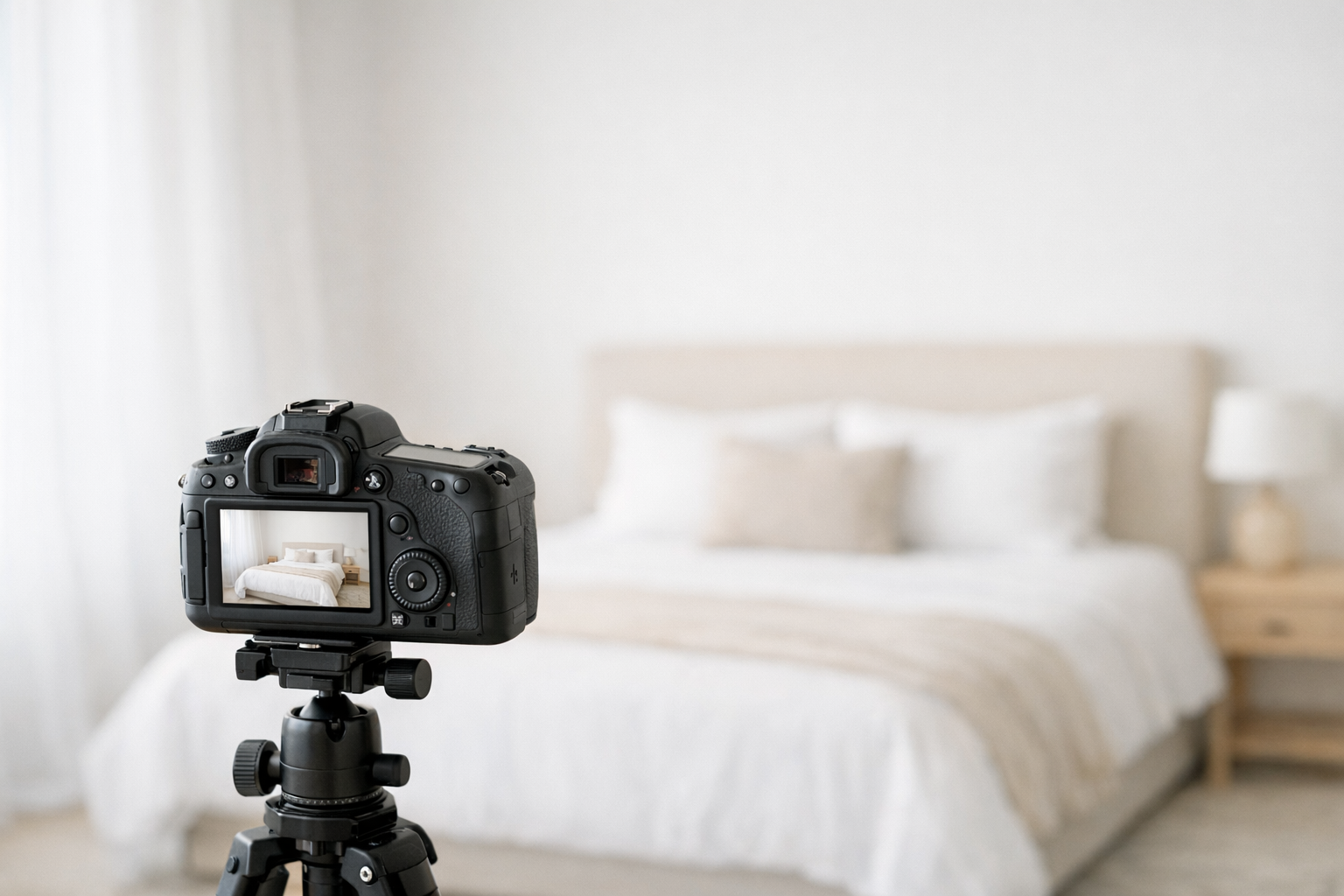
The power of the first impression in the holiday rental sector
In the hyper-competitive holiday accommodation market, a user's decision to click on your listing or scroll past is made in a fraction of a second. We live in a deeply visual era. Consumer behaviour studies show that the human brain processes images up to 60,000 times faster than text. Therefore, your property's visual material is not a simple decorative element; it is the most powerful conversion tool at your disposal.
When a potential guest browses platforms like Airbnb, Booking.com or Vrbo, they face an endless sea of options. In this scenario, a spectacular cover image, with flawless lighting and suggestive framing, immediately stands out from the dark, crooked or low-quality photos of the competition. It does not matter if your property boasts the best amenities on the market or a privileged location: if you cannot convey that value proposition through the screen, the user will never read your description or learn about your services.
Investing in a high-quality photoshoot should not be considered an expense, but rather one of the most profitable investments for your hospitality business. Throughout this comprehensive guide, we will analyse in depth how to plan, execute and optimise your property's visual material to transform casual visits into confirmed bookings.
Why investing in quality images offers the highest return on investment (ROI)
Many property owners and holiday let managers hesitate to hire a specialist photographer, thinking that modern smartphone cameras are enough. However, the difference between an amateur and a professional image goes far beyond camera resolution. It is about mastering light, understanding the volume of spaces and, above all, knowing how to tell a story that sparks the desire to travel.
An immediate increase in click-through rate (CTR)
The algorithm of the main Online Travel Agencies (OTAs) rewards listings that generate more engagement. An attractive primary image drastically increases your CTR (Click-Through Rate). The more users click on your listing, the better the algorithm will position your property in organic search results, creating a virtuous circle of visibility and sales.
Justification of higher nightly rates
The perception of value is directly linked to visual aesthetics. An apartment presented with bright, clean and elegant images conveys a sense of luxury, comfort and professionalism. This allows you to position your property in a higher price segment. Guests are willing to pay more for accommodation that looks immaculate and safe in photos, as it reduces travel uncertainty.
Reduction of misunderstandings and negative reviews
A well-executed professional photoshoot shows the space in an attractive yet realistic way. By using appropriate lenses that do not distort reality (avoiding the excessive use of extreme fisheyes), the guest knows exactly what to expect upon arrival. This prevents guest frustration, reduces complaints and translates into five-star reviews, which are the engine of your business's reputation.
Preparing the accommodation before the photoshoot (Home Staging)
The success of a photoshoot is decided long before the photographer presses the shutter button. The process of preparing the property to be photographed is known as Home Staging, and its goal is to make every room look spacious, welcoming and aspirational.
The golden rule: Absolute cleanliness and order
The camera is unforgiving. A hair on the pillow, a fingerprint on the tap, a foggy mirror or a loose cable will be magnified in the final photograph. Before the shoot, it is essential to carry out a deep and thorough clean of every corner of the property.
To ensure that the cleaning team does not overlook any critical detail before the photographer arrives, it is extremely useful to use professional tools such as Macufy's control forms. These interactive checklists guarantee that every room is in perfect condition and ready to be immortalised by the camera, preventing unnecessary delays on the day of the shoot.
Depersonalisation and minimalism
The guest must be able to picture themselves living in your accommodation. To achieve this, you must remove any excessively personal or everyday objects that break the visual magic:
- Remove personal hygiene products from showers and bathroom countertops (used shampoos, toothbrushes).
- Hide rubbish bins, brooms, tea towels and cleaning products.
- Conceal all cables from appliances, televisions and chargers.
- Clear kitchen worktops and table surfaces, leaving only a few selected decorative items.
Strategic decoration and creating scenes
It is not about showing a cold, empty space, but about bringing it to life in an elegant way. You can create small "stills" or scenes that evoke moments of pleasure and relaxation:
- In the dining area or terrace: Set a breakfast table with beautiful cups, a designer coffee maker, plates with fresh fruit or croissants, and an open newspaper or book.
- In the living room: Place a light throw with soft textures artistically folded over the sofa, accompanied by cushions that contrast harmoniously with the room's colours.
- In the bedroom: Dress the bed with perfectly ironed sheets (creases show up dramatically in photos). Use multiple layers of pillows and scatter cushions to add volume, and add a throw at the foot of the bed.
- In the bathroom: Place fluffy, neutral-coloured towels, preferably white, neatly folded or rolled, accompanied by an artisanal soap or a small plant to add green freshness.
Key technical aspects of interior photography
Even if you delegate this work to a professional, knowing the technical aspects will help you evaluate the quality of the hired work and understand why certain approaches work better than others.
Mastering light: The soul of photography
Natural light is the most valuable resource in interior photography. It brings warmth, spaciousness and an unrivalled sense of well-being. The photographer must plan the shoot according to the property's orientation to take advantage of the best light in each room.
Generally, soft and diffused light is preferred, avoiding the direct midday sun which creates harsh shadows and difficult-to-manage contrasts. The so-called "golden hour" (just after sunrise or before sunset) is excellent for exterior shots, terraces or rooms with large windows. Likewise, the twilight "blue hour" is ideal for capturing facades or pool areas with the property's artificial lighting turned on, creating a magical and highly attractive atmosphere.
Shooting angles and camera height
In real estate and holiday rental photography, camera height and angle are decisive in conveying stability and realism:
- Perfect vertical lines: This is an unbreakable rule. Walls and door frames must be completely vertical in the image. If the camera tilts up or down, the lines converge, giving the impression that the walls are falling over, which ruins the professionalism of the shot.
- Medium height: The camera is usually placed at chest or even waist height (especially in kitchens and bathrooms) to capture both floor and ceiling in a balanced way, showing the three-dimensionality of the space naturally.
- Corner shots vs. straight-on shots: Photos taken from the corners of a room help show the spaciousness and layout of the space. On the other hand, symmetrical straight-on shots provide an editorial design feel, very modern and elegant, ideal for highlighting specific areas such as bed headboards or fireplaces.
The correct use of wide-angle lenses
To capture entire rooms, it is necessary to use wide-angle lenses. However, there is a very fine line between a wide shot and unrealistic distortion. Lenses with extreme distortion or "fisheyes" stretch the corners, making a small bathroom look like a dance floor. This generates distrust in the guest, who will feel disappointed upon arrival to discover the actual size. A professional photographer will use focal lengths equivalent to 16mm - 24mm in full-frame format, correcting any optical distortion using specialised software.
The essential shot list for your listing
To ensure your photo gallery covers all the customer's information and persuasion needs, you should work with a structured list of mandatory shots.
1. The cover photo (Your main visual hook)
This is the most important image in your entire marketing strategy. It must be the most spectacular, representative and magnetic photo of the property. It could be a panoramic view of the terrace overlooking the sea, the main living room bathed in sunlight, or a pool lit up at sunset. It must summarise the core experience you offer.
2. The living room and seating areas
Show the space where guests will spend their relaxing time. At least two general shots from opposite angles are recommended so that the relationship of the living room with the rest of the house is understood (for example, the connection to the dining room or the exit to the terrace).
3. Bedrooms: Havens of rest
Each bedroom should have a general photo showing the entire bed, bedside tables and ambient lighting. It is vital to convey a sense of comfort, freshness and hygiene. If the bedroom has views of the outdoors, make sure they are visible through the window without it being completely blown out by excess outdoor light.
4. The kitchen: Functionality and equipment
Travellers who choose holiday apartments highly value the ability to cook. Show a clean, well-equipped and modern kitchen. Capture a general shot and a close-up of key appliances (capsule coffee machine, toaster, high-quality tableware).
5. Bathrooms: Spotless cleanliness
The bathroom is one of the rooms that most influences booking decisions. It must look gleaming. Take shots that show the shower or bath, the sink and complimentary details (towels, toiletries, hairdryer). Avoid at all costs making the toilet the main focus of the frame; if possible, keep the lid down and frame towards more aesthetic areas.
6. Exteriors, terraces and communal areas
If your property has a balcony, terrace, garden or pool, these photos must be treated with the highest priority. Show the outdoor furniture (sun loungers, tables for outdoor dining) and the views that guests will enjoy. Do not forget to include photos of the building's communal areas if they add value (gym, padel courts, direct beach access).
The importance of detail and lifestyle photos
While wide-angle photos serve to explain the layout and size of the property, detail photos serve to connect emotionally with the guest. These images capture the atmosphere and small luxuries that make your accommodation unique.
A close-up of a steaming cup of coffee next to a book on the terrace, the detail of fresh flowers on the wooden table, the texture of a high-quality wool throw, or the stream of water from a rainfall shower with bath salts nearby... These images do not sell square footage; they sell experiences, sensations and moments of happiness. Interspersing these lifestyle photos in your gallery humanises the accommodation and generates an irresistible desire to be there.
How to optimise images to improve SEO rankings
Having the best photos in the world is useless if your website takes forever to load or if search engines cannot interpret what your images show. The technical optimisation of your visual files is a fundamental pillar of On-Page SEO.
Smart compression without loss of quality
Professional cameras generate large file sizes. Uploading these images directly to your website will drastically slow down the loading speed, which harms user experience and penalises your Google ranking. You must optimise the file size of your images:
- Use modern high-compression formats like WebP, which offers excellent quality at a significantly lower weight than traditional JPEG or PNG.
- Adjust image dimensions to the maximum size they will be displayed on the web (for example, a width of 1920 pixels is usually more than enough for high-definition screens).
- Use lossless compression tools (such as TinyJPG or Compressor.io) to reduce the file size to under 200-300 KB per image before uploading them.
Descriptive filenames and alt tags
Search engines cannot "see" images in the same way humans do, so they rely on associated text to understand their content. Optimise these fields by using your keywords naturally:
- Filename: Forget generic names like
DSC_0492.jpgorphoto1.jpg. Rename your files with clear descriptions separated by hyphens, for example:master-bedroom-holiday-rental-malaga.jpgorsea-view-terrace-holiday-apartment.jpg. - Alternative Text (ALT Tag): This is the HTML attribute that describes the image for screen readers used by visually impaired people and for Google's crawlers. Write precise and context-rich descriptions:
<img src="..." alt="Master bedroom with double bed, white sheets and sea views in a holiday apartment in Malaga">.
Integrating photography into your global management strategy
Once you have a dream visual catalogue and your listings are perfectly optimised, the volume of visits and booking requests will experience remarkable growth. This is the moment when marketing excellence must be backed by flawless operational management.
To successfully channel this increase in demand and avoid any operational friction, it is vital to have a centralised system. The booking synchronisation offered by Macufy allows you to unify calendars from Airbnb, Booking.com, Vrbo and your own booking engine in real time. Thus, while your new photographs attract dozens of guests across different portals simultaneously, you will maintain absolute control of available dates, completely eliminating the risk of double bookings and ensuring a seamless user experience from the very first visual contact.
Common holiday rental photography mistakes to avoid at all costs
To ensure that your investment yields maximum returns, make sure you do not fall into the most common mistakes made by uninitiated owners:
- Leaving the toilet lid up: This is a basic aesthetic mistake that instantly ruins a bathroom's image, no matter how clean it is.
- Appearing in reflections: Pay special attention to mirrors, shower screens, windows and TV screens. The photographer or their equipment should never appear reflected in the shot.
- Shooting in bad weather: A grey, gloomy sky conveys sadness. Plan the shoot for sunny or slightly clear days that bring vibrant light and blue skies.
- Excessive digital retouching: Editing software should be used to correct lighting and enhance natural colours, never to distort reality. If you over-saturate colours or remove fixed structural elements, the guest will feel deceived upon arrival.
- Messy outdoors: If you photograph the terrace, make sure the plants are healthy and watered, outdoor cushions are placed symmetrically, and there are no dry leaves or dirt on the floor.
Conclusion: Your best digital marketing asset
In the digital tourism ecosystem, your photographs are your calling card, your 24/7 sales representative and a reflection of the care and love you put into your hospitality business. Outstanding images not only justify more competitive rates and increase occupancy, but they also build a solid and trustworthy brand in the long term.
Combine a meticulous staging, the expert eye of a professional photographer, rigorous technical SEO optimisation and a robust management platform like Macufy to coordinate your bookings efficiently. By unifying top-tier visual marketing with flawless operational management, you will ensure the sustained success and profitability of your holiday accommodation in a constantly evolving market.