
How to Avoid Complaints About Outdated Photos in Your Holiday Rental
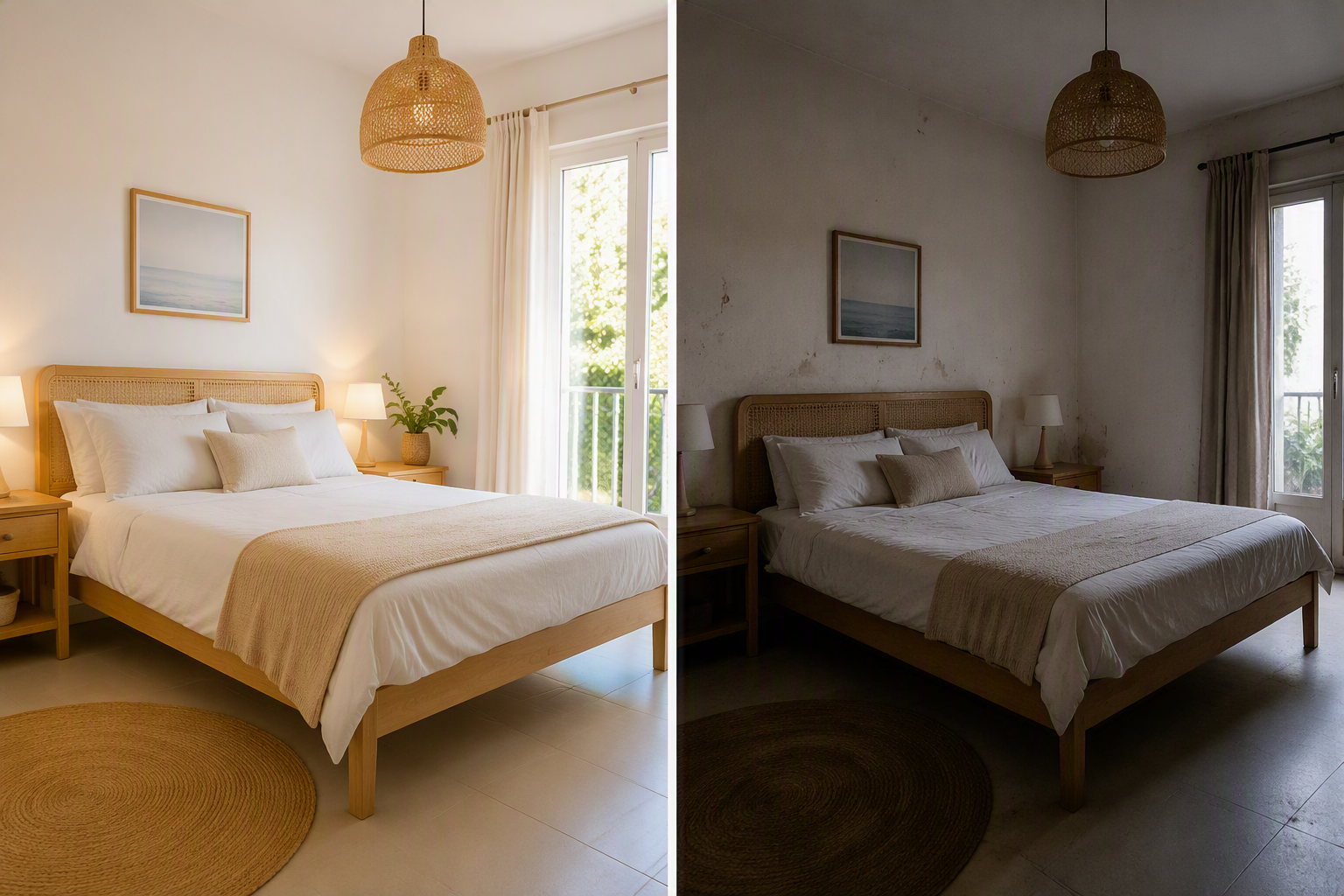
The Great Holiday Rental Dilemma: When Expectations Clash with Reality
In the fast-paced world of holiday home rentals and hospitality management, there are few phrases that strike as much fear into the heart of an owner or manager as: "The property looks nothing like the photos". This is the seed from which complaints, conflicts and, ultimately, the dreaded negative reviews germinate, which can damage the reputation and profitability of holiday accommodation in a matter of minutes. Managing expectations in holiday rentals is not just a good practice; it is an imperative necessity for long-term success.
The short-term stay market is, by nature, deeply visual. Guests, even before reading a single word of the description, immerse themselves in an imaginary journey through the images. They are seduced by the promise of a living room bathed in natural light, the serenity of a terrace with views, the minimalist design of a bedroom or the modernity of a kitchen. Holiday rental photography acts as the first and most powerful marketing tool, creating a visual narrative that the potential guest assimilates and internalises as the absolute truth of their future experience.
However, when that visual promise does not align with the physical reality they find upon opening the door, what is known in psychology as cognitive dissonance occurs. This gap between the imagined and the perceived generates immediate and deep frustration. The sofa that looked pristine and comfortable in the photo now shows obvious signs of wear and tear and a discreet stain; the sunny, clear terrace is, to their surprise, opposite a noisy construction scaffold; or the building's communal areas, conveniently omitted from the listing, reveal a state of neglect and dirtiness that completely contradicts the image of luxury or comfort projected by the interior.
This problem goes far beyond a simple annoyance. It becomes a catalyst for a series of negative consequences that directly affect the viability of the business. Refund requests, disputes on booking platforms (such as Airbnb or Booking.com) and, in the worst-case scenario, a one-star review, can penalise your listing's ranking for months, severely impacting your occupancy rates and income. To solve this problem at its root, offering apologies is not enough; it is essential to implement an active and proactive expectation management strategy, based on transparency, constant photo updates and rigorous quality control at every point of contact with the guest.
The Financial and Reputational Impact of Outdated Photos on Key Platforms
It is a common mistake among many holiday accommodation owners and managers to view investment in professional photography as a one-off expense, something done when listing the accommodation and then forgotten about. The "I already have nice photos, I don't need to spend on that again" mentality is, unfortunately, one of the most frequent causes of visual discrepancy complaints. What is often underestimated is that a holiday home, due to its high-traffic nature, suffers accelerated natural wear and tear. Furniture deteriorates, walls get dirty, textiles lose their brightness and colour, and appliances are replaced by different models over time.
When a guest detects significant discrepancies between what they booked and what they finally receive, the financial and reputational consequences are direct and often severe:
- Partial or full refunds that dent your income: Leading platforms like Airbnb and Booking.com have very robust consumer protection policies. If a guest can prove with photos (and sometimes videos or testimonials) that the furniture is notably older, damaged, or that there are dirty areas that differed drastically from the images on the platform, the booking channel may authorise a significant refund. This can range from 20% to 50% of the stay, or even relocating the guest to another accommodation at the owner's expense. These refunds not only represent a direct financial loss but also consume time and resources in managing the dispute.
- Drop in SEO ranking on channels and loss of visibility: Booking platform algorithms are designed to reward conversion and positive guest reviews. A streak of bad scores, especially those mentioning "misleading advertising" or "the property is not like the photos", will sink your listing in the search results. This means less visibility, fewer clicks and, ultimately, a drastic decrease in the number of bookings. Recovering lost positioning is a long and arduous process.
- Loss of Superhost or Preferred Partner status: Badges like Superhost on Airbnb or Preferred Partner on Booking.com are badges of honour that can increase your bookings by up to 30% and grant you greater visibility. However, maintaining these privileges requires consistent performance and very high average ratings (usually above 4.8 stars). A single serious complaint for "misleading advertising" or failing to meet expectations can cause you to lose these badges immediately, with the consequent loss of credibility and business opportunities.
- Damage to online reputation and negative word of mouth: Beyond platforms, a bad experience is shared. Whether through social media, review sites like TripAdvisor or simply word of mouth among friends and family, a damaged reputation is difficult to repair. Future guests research before booking, and warnings from other travellers are a powerful deterrent.
- Increase in last-minute cancellations: If a guest arrives, sees the discrepancy and decides it is not what they expected, they might cancel and look for other accommodation, even if it means losing part of their money. This leaves you with an empty property at the last minute, which is difficult to fill.
In short, the initial investment in high-quality holiday rental photography is essential, but keeping it updated is an ongoing strategy that protects your investment, your reputation and your income stream. Visual honesty is not a luxury; it is a cornerstone of sustainability in the accommodation industry.
Key Strategies for Successful Expectation Management
The best way to neutralise complaints about the property's condition and ensure guest satisfaction is through proactive management and unwavering transparency. This involves maintaining a dynamic visual catalogue and fluid communication.
1. Seasonal and Continuous Photo Updates
You cannot rely on photos you took three years ago if you have changed key elements of the accommodation, such as the curtains, the colour of the walls, the living room furniture or even the layout of certain spaces. The lifespan of a listing photo can be surprisingly short in the tourism sector.
The Image Update Schedule: Beyond the Obvious
It is highly recommended to carry out a full visual audit of the accommodation at least twice a year or, ideally, coinciding with each major season change (for example, before the high summer season and before the winter season). This does not necessarily mean hiring a professional photographer every six months for a full session, but it does mean a process of reviewing and renewing those images that show elements prone to change:
- Textiles and Decoration: If you change the bedspreads, sofa cushions, rugs or even the wall art to adapt them to the weather or new trends (light fabrics and fresh colours in summer, warm blankets and earth tones in winter), it is crucial that the photos reflect this. Small details make a big difference in guest perception.
- Plants and Gardens: The state of vegetation varies drastically depending on the time of year. A lush, flowering garden in spring or summer photos can lead to huge disappointment for a guest arriving in autumn who finds dry leaves, bare branches or empty pots. Show your garden as it will look during the booking season. Consider having photo sets for each season.
- Wear and Tear of Furniture and Equipment: If a main piece of furniture (sofa, bed, dining table) has suffered significant damage, has been visibly repaired or, more commonly, has been replaced by one of a different style, colour or size, that photo must be changed immediately. The same applies to major appliances like the TV, coffee maker or microwave.
- Minor or Major Renovations: Any painting work, bathroom or kitchen renovations, or even the addition of a new feature (such as a ceiling fan, a new air conditioning system or a barbecue on the terrace) must be visually documented.
- Changes in the Immediate Surroundings: If a noisy new business has opened nearby, major construction work has started, or the view from the terrace has changed due to a new building, these are situations that require immediate attention in the description and, if possible, in the photos.
This constant updating is the cornerstone of effective managing expectations in holiday rentals, ensuring that your property's "digital shop window" is always a true reflection of current reality.
2. How to Take Realistic Photos Without Losing Appeal
There is a fine line between attractive visual marketing and misleading exaggeration. The goal is to capture the beauty of your property honestly. To avoid falling into the trap of overpromising, follow these guidelines for authentic holiday rental photography:
- Avoid Excessive Use of Wide-Angle Lenses: Wide-angle lenses are valuable tools for showing the layout and spaciousness of a room. However, if used to the extreme, they can distort the perception of space, making a 20-square-metre studio look like a 60-square-metre luxury suite. Upon arrival, the guest will experience an unplanned sense of claustrophobia. Use natural angles that faithfully represent the actual space. If you use a wide angle, complement it with normal-angle photos.
- Natural Light vs. Artificial Filters: Make the most of sunlight to bring warmth, spaciousness and a cosy feel to your spaces. Schedule photo shoots at times of day with the best natural light. However, avoid oversaturating images with aggressive HDR filters or excessive editing that alters the actual colours of the walls, furniture and decor. If your wall colour is sand, it shouldn't look nuclear white in the photos. Authenticity in colours is key.
- Show Weak Points Naturally: Transparency builds trust. If the attic ceiling is low in some areas, include a photo where the height can be clearly appreciated. If the bathroom is small, don't try to hide it; an honest photo will prevent complaints from guests with reduced mobility or tall stature who need more space. If the property has a peculiar detail or limitation (for example, a steep staircase, a small window in an interior room, or an occasional noisy neighbour), it is better to show or describe it.
- Focus on Realistic Details: In addition to general shots, include photos of details the guest will actually use: the dinnerware set, the quality of the towels, the appliances, the personal hygiene products (if you offer them). This builds a more complete and honest picture.
- Ensure Impeccable Staging: Before each photo shoot, make sure the accommodation is spotless, tidy and decorated in a neutral and attractive way. Good staging is not about deceiving; it is about presenting your property in its best possible version, just as you expect your guests to find it.
3. Communal Areas and Surroundings: Managing Outdoor Expectations
A frequent and serious mistake is that owners limit themselves to photographing the interior of their apartment, deliberately omitting the building's communal areas or the immediate surroundings because they do not consider them "as attractive" as the interior. However, the guest experience does not start when they cross your doorstep, but from the moment they enter the building lobby or the development, and even before, when seeing the neighbourhood or street.
If your building entrance is old, lacks a lift (and the flat is on a high floor), or the facade needs renovation, you must report it visually and in writing. Adding real and honest photos of communal areas, such as the entrance lobby, corridors, stairs, bin area, parking or the common areas of an estate (swimming pool, gardens), helps filter the right guests and prevent unpleasant surprises.
For example, a young backpacker guest will probably have no problem climbing four flights of stairs in an old wooden building, but a family with a pram or an elderly couple will feel cheated and frustrated if they were not previously warned about the lack of a lift or the difficulty of access. Transparency in describing the surroundings drastically reduces last-minute cancellations, complaints during the stay and inevitable negative reviews. Include photos of the surroundings that show proximity to points of interest, but also the reality of the neighbourhood (pedestrian streets, parking areas, potential noise).
4. Cleanliness as a Critical Factor of Visual Perception
Often, the complaint that "the accommodation does not look like the photos" is not because the furniture is different, but because the lack of cleanliness makes everything look older, more worn and more neglected than it actually is. Accumulated dust on surfaces, blackened tile grout, stains on upholstery or rugs, mismatched or poorly organised crockery, and dirty windows convey a sense of neglect that completely destroys the neat and attractive aesthetic the guest saw in the high-definition photos.
Cleanliness is the foundation of a good guest experience. To ensure your property maintains exactly the same standard of neatness and freshness as the day the official photographs were taken, it is essential to have a strict verification system for the cleaning team. This is where digital property management tools, such as Macufy control forms, become an indispensable ally.
These forms allow you to create customised and detailed task lists for each room and for each type of property. Most importantly, you can require cleaning staff to upload real-time photos of the state of each room or specific elements before giving the green light for check-in. This way, you can remotely and confidently verify that:
- Cushions are placed in the same attractive arrangement as in the listing photos.
- There are no visible stains on either the sofa or the rugs.
- The crockery and kitchen utensils are complete, clean and attractively organised in the cupboards.
- High-wear areas, such as bathrooms and kitchens, shine and show no signs of accumulated wear or dirt.
- Beds are made with the same impeccable presentation as in the photos.
- All surfaces are free of dust and fingerprints.
- Supplies (toilet paper, soap, etc.) are replenished and neatly presented.
This verification capability not only ensures consistency in cleaning quality but also provides a layer of security and evidence in the event of disputes with guests regarding the condition of the accommodation. It is a powerful tool for quality management in tourist accommodation and a fundamental pillar for meeting visual expectations.
5. Proactive Communication: The Ultimate Shield Against Bad Reviews
Communication with the guest does not start when they arrive at the accommodation, but the very moment they make the booking, and even before, when they consult the listing. If you make temporary changes to the property or its surroundings (for example, if the communal pool will be closed for maintenance during their stay, if there is roadwork that could generate noise, or if a service you advertised is no longer available), you must communicate it immediately, clearly and concisely.
An excellent practice to mitigate any visual or functional discrepancy is to use Macufy's automated guest messaging. Through this scheduled messaging system, you can send a personalised and detailed welcome guide a few days before the traveller's arrival. In this document or message, you can include:
- Clarifications on Furniture or Decoration: "We want to let you know that we have recently updated our living room sofa to a more modern and comfortable light grey one. You can see the updated photo on our Airbnb/Booking profile." This prevents surprises and demonstrates proactivity.
- Detailed Access Instructions with Real Photos: Include real photos of the entrance gate, the building facade and distinctive street features. This helps the guest know exactly what to expect upon arrival and not feel disoriented if the exterior environment is not of modern design or if the entrance is less attractive than imagined.
- Honest Warnings about Limitations: "Our property is located in a historic building with special charm, so the stairs are narrow and we do not have a lift. We recommend travelling with light luggage if possible for your comfort." Or "The apartment is located in the heart of the leisure area, ideal for enjoying the nightlife. Please note that there may be ambient noise during weekends."
- Information about Works or Maintenance: "We would like to inform you that the communal pool will be closed for maintenance from [Start Date] to [End Date]. We apologise for any inconvenience this may cause."
- Practical Tips about the Area: Recommending where to park, where to shop, nearby restaurants, etc.
This level of honesty, proactivity and detail completely disarms any subsequent attempt to complain. The guest feels that the owner is honest, professional and cares about their experience, which increases trust and predisposes the traveller to value their stay positively, prioritising transparency over small aesthetic details that might not be perfect. It is a fundamental strategy for optimising listings on Airbnb and Booking and for long-term reputation.
Guest Psychology and the Importance of Realistic Expectations
Understanding how the guest's mind works is crucial for effective expectation management. When a traveller looks for accommodation, they are not just looking for a place to sleep; they are looking for an experience, a promise of comfort, adventure or relaxation. The images and descriptions in your listing build that promise. The discrepancy between expectation and reality not only generates disappointment but also triggers psychological mechanisms that can magnify frustration.
- Cognitive Dissonance: As mentioned, when what is expected does not match what is perceived, the brain tries to resolve that inconsistency. This often translates into an active search for "faults" or "proof" that the property does not deliver as promised, even in minor details that would otherwise go unnoticed.
- Primacy Effect: First impressions count. If the guest arrives and the first thing they see differs negatively from the photos, that initial impression will colour their entire perception of the stay, no matter how good the rest of the experience is.
- Confirmation Bias: Once a negative impression has been formed, the guest tends to look for and remember information that confirms that impression, ignoring or minimising the positive aspects.
- The Power of Positive Surprise: Conversely, if expectations are realistic (or even slightly conservative) and the guest finds the property is even better than they imagined, a positive surprise is generated. This not only leads to stellar reviews but also fosters loyalty and positive word of mouth. It is easier to exceed a modest expectation than an inflated one.
Therefore, expectation management is not just about avoiding complaints; it is about building a relationship of trust with the guest from the first contact, ensuring that their experience is, at the very least, as good as promised, and hopefully, better.
Technology at the Service of Transparency and Quality in Holiday Rentals
In the digital age, technology has become an indispensable ally for property managers looking to optimise their operations and, crucially, maintain the integrity of their listings. Platforms like Macufy.com are designed specifically to address these challenges.
Automation and Centralisation for Efficient Management
The management of holiday properties is complex, with multiple tasks ranging from guest communication to coordinating cleaning and maintenance teams. Technological solutions allow much of these processes to be automated, freeing up valuable time and minimising errors.
- Automated Messaging: We have already discussed the importance of automated guest messaging. Macufy allows you to schedule personalised messages before, during and after the stay, including crucial information about the property, access, the surroundings and any relevant changes. This ensures that all guests receive key information consistently and in a timely manner, reducing the need for the manager to manually respond to repetitive questions.
- Control Forms and Digital Checklists: Macufy control forms are a powerful tool to guarantee quality. They allow you to create detailed checklists for cleaning tasks, maintenance and inventory review. Staff can complete these forms from their mobile device, marking tasks as completed and, most importantly, uploading photos as visual proof of the property's condition before check-in. This not only ensures the property is spotless but also provides an auditable record in case of disputes.
- Centralised Booking Management: A Property Management System (PMS) like Macufy centralises all bookings from different channels (Airbnb, Booking.com, your own website) into a single calendar. This avoids overbookings and simplifies management, allowing the manager to have a complete view of occupancy and coordinate resources more effectively.
- Listing Synchronisation: The ability to synchronise and update your listing information (including photos and descriptions) from a single platform to all your distribution channels is essential. This ensures consistency and prevents outdated versions of your property from circulating on the internet.
By integrating these tools, managers can not only optimise their operations but also strengthen guest trust by ensuring a consistent and transparent experience, which is vital for the online positioning of tourist accommodation.
Detailed Action Plan to Audit and Optimise Your Holiday Accommodation's Image
If you want to ensure that your property delivers what is promised online and offer a five-star experience, we propose carrying out the following step-by-step visual and operational audit. This plan will help you identify and correct any discrepancy between expectation and reality.
Step 1: The Mirror Test (In-Person and Critical Inspection)
Enter your accommodation not as an owner, but as if you were a demanding guest who has just arrived. Have your mobile phone in hand and open your property listing on the main booking platform (Airbnb, Booking.com, etc.). Go room by room, space by space, and meticulously compare each photo with what is in front of your eyes. Ask yourself the following questions, being brutally honest:
- Is the colour of the walls still the same vibrant shade as in the photos, or does it look dull, dirty or in urgent need of a coat of paint?
- Are the pictures, plants, decorative elements and furniture in exactly the same place and in the same condition as shown in the images? Is there anything missing, broken or worn out?
- Is there any visible appliance (such as the coffee maker, microwave, toaster) that has been replaced by another of a different colour, brand or model, affecting the kitchen's aesthetic?
- Is the view from the window or terrace exactly the same, or have there been significant changes in the urban or natural landscape?
- Does the quality of natural light match that of the photos, or were they taken at an ideal time of day that is rarely repeated?
- How do the building's communal areas (entrance lobby, stairs, corridors) look? Are they clean, well-lit, or do they give an impression of neglect that contrasts with the interior?
Take detailed notes and, if necessary, new photos with your mobile to document discrepancies. This is the basis for your improvement plan.
Step 2: Remove, Replace or Photograph What is Worn Out
Based on your audit from Step 1, prioritise actions. If you detect that a key piece of furniture (such as the mattress, sofa, dining chairs, or even a large rug) shows obvious signs of sagging, unremovable stains, tears or deep scratches, you have two options:
- Replace It Immediately: This is the ideal option if your budget allows and the item is crucial for guest comfort and aesthetics. A sagging sofa or an uncomfortable mattress are guaranteed complaints.
- Photograph and Replace the Image in the Listing: If you cannot afford to replace the item at that moment, it is imperative that you take a real photo and replace the one in the listing. It is preferable for the guest to book knowing the sofa is old or slightly worn rather than getting an unpleasant surprise upon arrival. Honesty, even if it hurts, is always the best policy.
Extend this principle to broken decorative items, withered plants or appliances in poor condition. Remove or repair them. The accumulation of small defective details creates an overall impression of neglect.
Step 3: Update Text Descriptions for Total Transparency
Photos must always be complemented by precise, honest and detailed descriptions. Words are just as important as images for expectation management. Review every sentence of your listing with a critical eye:
- Be Specific and Avoid Hyperbole: If your terrace has partial sea views (but you have to lean out to see it), do not write "Frontal sea views". Describe: "Side sea views from the terrace, visible when leaning out."
- Warn about Potential Inconveniences: If the apartment is located in a very busy nightlife area, state it clearly: "Located in the heart of the vibrant leisure area, ideal for enjoying the nightlife. Please note that there may be ambient noise during weekends and at night." This simple phrase will save you dozens of noise complaints.
- Detail Physical Limitations: If access is via steep stairs, if the bathroom is small, if the kitchen lacks an oven, or if parking is tricky, include it in the description. "Access to the third floor without a lift, ideal for active travellers."
- Describe the Surroundings: Do not limit yourself to your property. Briefly describe the type of neighbourhood, proximity to essential services (supermarkets, pharmacies) and tourist attractions, as well as any peculiar feature of the surroundings that could affect the guest experience.
This comprehensive review of your texts, along with the photographic update, is the key to optimising listings on Airbnb and Booking that generates quality bookings and satisfied guests.
Step 4: Implement a Continuous Quality Control System
The audit is not a one-off event. It is an ongoing process. Use tools like Macufy control forms to ensure your cleaning and maintenance team follows the standards you have established. Schedule periodic reviews (monthly or quarterly) where you or a supervisor repeat "Step 1" to detect any wear or changes before they become a problem.
Step 5: Encourage Guest Feedback
Create a simple channel for guests to offer feedback during their stay. A "how is everything going" message 24 hours after check-in, sent via Macufy's automated messages, can allow you to address small issues before they escalate into a negative review. Show that you value their opinion and are willing to act.
The Future of Property Presentation: Beyond Static Photography
While holiday rental photography remains fundamental, the future of holiday property presentation is leaning towards even more immersive and transparent experiences. Emerging and existing technologies are transforming how guests interact with listings before booking:
- 360 Virtual Tours and Virtual Reality (VR): Virtual tours allow guests to "walk" through the property from the comfort of their home. This almost completely eliminates the gap between expectation and reality, as the guest experiences the space as it is. The initial investment is higher, but the return in terms of trust and reduced complaints is invaluable.
- High-Quality Videos: A well-produced video can show the flow of the property, natural light in motion, the neighbourhood atmosphere and the functionality of spaces in a way that static photos cannot. It is a powerful tool to convey the "feel" of the property.
- Interactive Maps and Street View: Integrating Google Street View or interactive maps showing the exact location and immediate surroundings of the property can be an excellent way to manage expectations about the neighbourhood, proximity to points of interest and the building facade.
- Augmented Reality (AR) for Specific Details: Although still in early stages for the general public, AR could allow guests in the future to visualise specific elements of the property in their own environment or interact with additional information overlaid on images.
Adopting these technologies not only positions your business at the forefront but also reinforces your commitment to transparency and the guest experience, key elements for customer loyalty in holiday rentals.
Conclusion: Honesty as the Best Conversion and Sustainability Strategy
In the holiday accommodation sector, overselling expectations is a short-term victory that translates into a catastrophic long-term defeat. A listing that exaggerates a property's virtues may indeed get many initial bookings, but it will quickly be destroyed by an avalanche of negative reviews, claims and refunds that will scare away future customers and erode your brand's credibility.
Conversely, accommodations that manage expectations honestly, keep their photos updated season after season, offer precise and transparent descriptions, and guarantee an impeccable standard of cleanliness using professional control tools (like those offered by Macufy), not only avoid dreaded complaints and the impact of outdated photos, but also succeed in building customer loyalty and maintaining an excellent rating consistently over time. These businesses build a solid reputation that attracts more guests and allows for organic, sustainable growth.
At the end of the day, trust is the most valuable asset of your hosting business. Investing in transparency, the quality of your images and proactive communication is not an expense, but a strategic investment that protects your brand, optimises your income and ensures long-term success in an increasingly competitive market. Honesty is not just the best policy; it is the best conversion strategy and the key to truly successful expectation management in holiday rentals.