
From Rustic to Tourist Paradise: How to Prepare Land in Galicia for Holiday Accommodations and Hotels
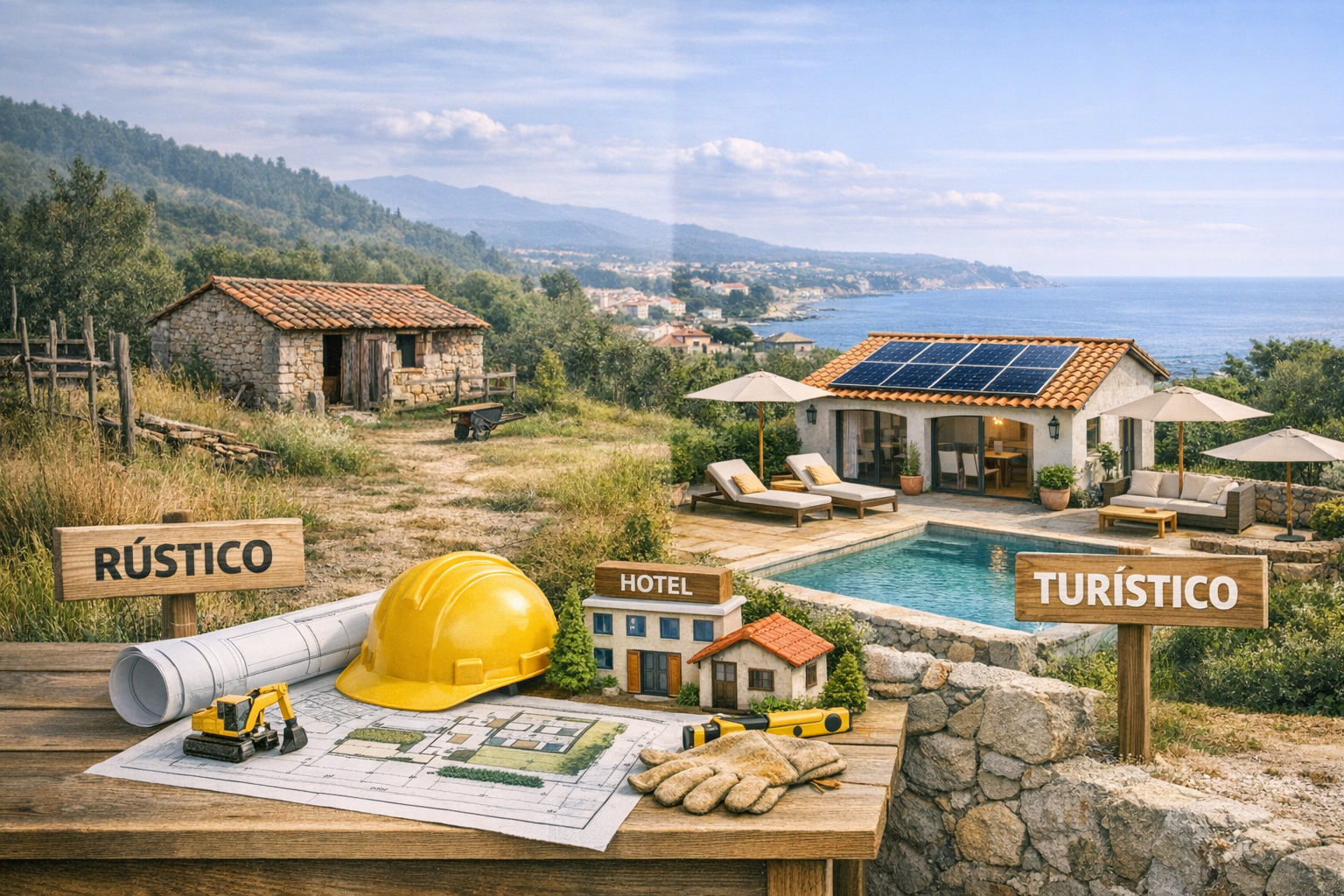
Is it possible to transform rustic land into buildable land for tourism in Galicia? The legal reality
The idea of turning rustic land into a thriving tourism project in Galicia is a dream shared by many. Imagining a country house, a charming boutique hotel or even a holiday home complex emerging from the tranquillity of the Galician countryside is, without a doubt, an attractive vision. However, the reality of preparing land in Galicia for tourist accommodations, especially when we talk about rustic land, is a process that requires a deep understanding of the legal framework and a well-defined strategy. It is not simply a matter of 'reclassifying land' in the traditional sense of changing its general classification to urban, but of obtaining a specific authorisation for an exceptional use.
At Macufy.com, we understand that the first step towards the success of any tourist accommodation is to ensure its legality and viability from the ground up. Therefore, we will break down the complexities of Galician regulations to offer you a clear and precise guide on how to approach this challenge.
The regulatory framework: The Galician Land Law (LSCG) and planning instruments
The backbone of urban planning in our autonomous community is Law 2/2016, of 10 February, on the land of Galicia (LSCG), complemented by its regulations, Decree 143/2016. This legislation sets out the basis for land classification, the permitted uses in each type, and the procedures for any alteration or development. It is essential to understand that the LSCG seeks to preserve the value of rustic land, limiting its indiscriminate transformation into urban or developable land as much as possible.
The philosophy behind this law is to protect the landscape, natural resources, the environment, and agricultural and forestry activities, which are pillars of Galician identity. Therefore, any initiative that aims to develop an economic activity on rustic land, such as a tourism project, must demonstrate exceptional compatibility with these values and, often, a public or social interest that justifies a derogation from the general rule.
General Municipal Development Plan (PXOM) and its role
Each Galician municipality has a General Municipal Development Plan (PXOM). This document is the local planning law and details the classification of land within its municipal boundary. The PXOM is the first place you should look for specific information about your plot. It will indicate whether your land is classified as:
- Urban Land: Already has all services and is consolidated for building.
- Developable Land: Requires a development plan to become urban.
- Rustic Land: The one we are concerned with, and where building possibilities are very limited.
The PXOM can also establish specific zoning within rustic land, with particular regulations for each. For example, there may be areas of landscape, agricultural or forestry protection that impose additional restrictions or, conversely, zones where certain tourism uses are expressly contemplated under very specific conditions.
Other sectoral and special plans
In addition to the PXOM, there are other planning instruments of higher or complementary rank that may affect your project. These include:
- Coastal Management Plans (POL): If your land is near the coast, the POL will be decisive, as it imposes very severe restrictions on building in coastal areas.
- Natural Resource Management Plans (PORN) or Master Plans for Use and Management (PRUG): For land located in protected natural spaces (natural parks, Natura 2000 Network), these plans are a priority and usually prohibit or drastically limit any new construction.
- Sectoral Plans: Such as infrastructure management plans (roads, railways) or services (energy, water), which can affect the buildability or access to your plot.
It is crucial to carry out an exhaustive study of all applicable regulations for the specific location of your land to avoid unpleasant surprises in advanced stages of the project.
The classification of rustic land in Galicia: Typologies and their implications
Not all rustic land is the same. The LSCG establishes different categories of rustic land, each with its own limitations and possibilities. Understanding these differences is key to evaluating the viability of your holiday home or hotel project on rustic land.
Rustic Land under Ordinary Protection
This is the most common category. On rustic land under ordinary protection, buildings and uses linked to agricultural, livestock, forestry or fish farming operations are permitted. Residential uses associated with these operations are also contemplated, provided they are necessary for their functioning. For tourism projects, this category offers a window of opportunity through 'exceptional uses' or 'uses of public interest', which we will look at in detail later. It is the type of rustic land where there is more flexibility, although always under strict conditions.
Rustic Land under Agricultural, Forestry, Water, Coastal, Landscape Protection, etc.
These categories imply a higher level of protection and, therefore, more severe restrictions. For example:
- Rustic Land under Agricultural Protection: Intended to preserve high-value productive land. Buildings are usually even more limited to those directly related to agricultural activity.
- Rustic Land under Forestry Protection: Protects forest masses and reforestation areas. Construction is highly restricted.
- Rustic Land under Water Protection: Near rivers, reservoirs or aquifers. Water Law regulations apply, with construction limitations in easement and policing zones.
- Rustic Land under Coastal Protection: Within the protection easement zone of the maritime-terrestrial public domain, restrictions are drastic, often prohibiting new buildings.
- Rustic Land under Landscape Protection: Seeks to preserve views and environments of special aesthetic value. Any intervention must be minimal and perfectly integrated.
In these special protection categories, the possibilities of reclassifying rustic land to buildable for a tourism project are extremely reduced, if not impossible, for new constructions. The only exception could be the rehabilitation of legally existing buildings with heritage value, provided that the volume and typology are maintained.
Rural Settlements and their potential
A particular and very interesting situation for tourism development is that of rural settlements. PXOMs usually delimit these areas within rustic land as zones with some building consolidation, where rehabilitation, reconstruction and, occasionally, even new construction for residential or tourism purposes is permitted, following traditional typologies and always respecting the character of the settlement. If your land is within a delimited rural settlement, the possibilities of developing a tourism project are significantly higher, as the regulations are more flexible and designed to encourage life and activity in these areas.
Permitted uses and buildings on rustic land (exceptions to the general rule)
The LSCG prohibits, as a general rule, new residential buildings or uses that imply an urban transformation of rustic land. However, there are crucial exceptions that open the door to tourism projects. Article 35 of the LSCG is key in this regard.
Buildings linked to agricultural, livestock, and forestry operations
Although it is not our main objective, it is important to understand that the law allows constructions directly related to primary activity. For example, agricultural warehouses, stables, forestry sheds. In some cases, a link can be argued between tourist accommodation and an existing agricultural operation (agritourism), which facilitates the process.
Public or social interest: Facilities, infrastructure
This is one of the most relevant routes for larger-scale projects. The law allows buildings and facilities of public or social interest that must be located in rural areas. Proving that a tourism project meets this requirement is a challenge, but not impossible. It must be justified that the accommodation will generate employment, boost the local economy, promote the cultural or natural heritage of the area, and that its location on rustic land is indispensable due to its characteristics (for example, due to the need for large spaces or its integration into a specific natural environment).
Rural tourism and agritourism activities: The key to our goal
This is where the main opportunity lies. The LSCG expressly permits buildings and facilities for rural tourism, campsites, hostels, and other buildings for tourism or leisure use that are compatible with the protection of rustic land and with the rural development model. This is the gateway for your holiday rental or hotel project in Galicia.
To fit into this category, your project must meet a series of strict conditions:
- Environmental and landscape compatibility: The building must integrate into the environment, use traditional construction materials and typologies, and not generate a negative impact on the landscape or natural resources.
- Not generating a new population settlement: The project cannot imply a covert urbanisation or the creation of a new settlement. It must be an isolated building or a coherent group within the environment.
- Access to services: Access to basic services such as water, sanitation, and electricity must be guaranteed, preferably through connection to existing networks or, failing that, with sustainable autonomous solutions.
- Link to the rural environment: The project must contribute to rural development, either through the offer of activities related to the environment (hiking, local gastronomy, culture), the creation of local employment, or the promotion of local products.
The path towards a tourism project on Galician rustic land: Strategies and requirements
Once the legal framework is understood, it is time to map out the strategy to make your tourist accommodation project on rustic land in Galicia a reality. There are no shortcuts, but there is a clear path that, with proper planning, can lead to success.
The 'Public or Social Interest' and 'Complementary Activity' route
As mentioned, these are the two main routes to justify a tourism use on rustic land. It is essential to argue solidly why your project must be located on this type of land and what benefits it will bring.
What is considered 'public interest' for a tourism project?
Demonstrating the public or social interest of a tourism project implies going beyond mere private economic benefit. You must argue how your initiative contributes to the general well-being of the community. Some examples of criteria that can justify it are:
- Job creation: Direct and indirect in the area.
- Economic revitalisation: Attracting visitors, consumption in local businesses, promotion of local products.
- Heritage recovery: Rehabilitation of existing buildings with historical or ethnographic value.
- Valuing natural or cultural resources: Promotion of hiking trails, gastronomy, local crafts, etc.
- De-seasonalisation of tourism: An offer that attracts visitors throughout the year.
- Sustainability: Implementation of environmentally friendly practices, renewable energies, efficient waste management.
It is crucial that your project aligns with the policies of the Xunta de Galicia for the promotion of rural and sustainable tourism.
How to demonstrate complementarity with the rural environment?
The 'complementary activity' or 'rural tourism' route is the most direct for a holiday home or a rural hotel. Here, the key is integration and symbiosis with the environment. Your project must not be an alien element, but a natural extension of rural life. This is demonstrated through:
- Architectural design: Use of local materials (stone, wood), traditional Galician typologies, volumes that integrate into the landscape.
- Service offering: Activities that value the environment (guided routes, craft workshops, tastings of local products, participation in agricultural work).
- Sustainable management: Responsible use of natural resources, waste minimisation, promotion of biodiversity.
- Proximity to an existing operation: If you already own an agricultural or livestock operation, an agritourism project linked to it will have a better chance of success.
In essence, it is about demonstrating that your tourism project not only respects the rural environment, but enriches it and forms an intrinsic part of it.
Key requirements for the authorisation of tourism uses on rustic land
Beyond the justification of public interest or complementarity, there are technical and urban planning requirements that your project must scrupulously meet.
Minimum and maximum plot dimensions
The LSCG and the PXOMs establish minimum plot areas to be able to build on rustic land. These can vary significantly depending on the municipality and the category of rustic land, but they usually range between 2,000 and 10,000 square metres for new buildings. The aim is to avoid excessive subdivision and saturation of the territory. Furthermore, although less common, there could be maximum limits to prevent the excessive concentration of buildings on a single property.
Footprint and buildability
These parameters limit how much you can build on your plot. The footprint refers to the percentage of the plot's surface area that can be covered by the building (generally very low on rustic land, between 5% and 15%). The buildability is the total number of square metres built allowed for each square metre of the plot. These coefficients are much more restrictive on rustic land than on urban land, seeking to minimise the visual impact and the waterproofing of the land.
Landscape integration and sustainability
This is a critical point. A Landscape Integration Study will be required to demonstrate how the building adapts to the environment, what materials and colours will be used, how views, vegetation, and land slopes will be managed. Sustainability is not just an option, but a requirement: efficient water use, waste management, energy efficiency, use of renewable energies, etc. All of this must be reflected in the project.
Access to basic services (water, electricity, sanitation)
It is essential to demonstrate that the plot is guaranteed access to essential services. If there is no connection to public networks, you must propose autonomous solutions that are viable and environmentally friendly (legal wells, individual treatment plants, solar panels, etc.). The viability of these solutions will be evaluated by the competent bodies.
Environmental Impact Assessment (EIA) or Simplified Environmental Assessment
Depending on the magnitude and characteristics of your project, as well as the location (especially if it is in protected areas), an Environmental Assessment is highly likely to be required. An Environmental Impact Assessment (EIA) is a complex process that evaluates the potential effects of the project on the environment and proposes corrective measures. For smaller-scale projects, a Simplified Environmental Assessment might be sufficient. This report is crucial and can determine the viability or otherwise of the authorisation.
Favourable report from the competent sectoral administration (Turismo de Galicia)
Given that your goal is a tourism project, you will need the approval of the Consellería de Cultura e Turismo, through Turismo de Galicia. This body will evaluate whether your proposal complies with tourism regulations, meets quality standards, and contributes to the desired tourism model for the region.
Types of viable tourism projects on rustic land
The flexibility of the LSCG allows for various types of accommodation, provided they meet the integration and sustainability requirements.
Properties for Tourist Use (VUT) and country houses
These are the most common options and, often, the most accessible. A property for tourist use on rustic land can be a newly built house or, more frequently, the rehabilitation of an existing building (an old farmhouse, a mill, etc.). Country houses have specific requirements regarding typology and the services they must offer, seeking an authentic experience linked to the environment.
Rural hotels, agroturismo, active tourism
For a rural hotel, the plot requirements and justification of public interest are usually higher. Agritourism, which combines accommodation with agricultural or livestock activities, is a highly valued modality with greater facilities. Active tourism projects (equestrian centres, hiking, adventure sports with associated accommodation) can also fit, provided the building is auxiliary to the main activity and does not generate a disproportionate impact.
Campsites and unique accommodations
Campsites and glampings (luxury camping) are another option on rustic land, with specific regulations. Unique accommodations, such as treehouses, transparent domes or other types of innovative structures, can also be authorised if they meet the criteria for landscape integration, sustainability, and non-permanence of the building (in some cases).
The administrative process for the viability of your tourism project
The bureaucratic path to reclassify rustic land for tourism use in Galicia is long and requires patience and meticulousness. Here we detail the key steps:
The prior consultation: A fundamental first step
Before investing time and money in a detailed project, it is ABSOLUTELY CRUCIAL to carry out a prior consultation. This will allow you to get an initial assessment of the viability of your idea.
Who to talk to? Town Hall, Xunta de Galicia
- Town Hall (Ayuntamiento): Go to the planning department of your municipality. They will inform you about the PXOM, the specific classifications of your plot, and local requirements. It is the first filter.
- Xunta de Galicia: Contact the Consellería de Medio Ambiente, Territorio e Vivenda (or the planning department of the Xunta) and Turismo de Galicia. They will give you a broader overview of regional and sectoral regulations.
Documentation required for the consultation
For the prior consultation, you will need at least:
- Cadastral reference of the plot.
- A general description of your project idea (type of accommodation, number of beds, estimated surface area).
- A site plan of the plot.
With this information, the technicians will be able to offer you initial guidance on the possibilities and main obstacles.
The application for exceptional use authorisation on rustic land
If the prior consultation is favourable, the next step is the formal processing of the authorisation. This process begins at the town hall but involves the participation of multiple bodies.
Basic Project and Justificative Report
You must commission an architect to draw up a Basic Project detailing the proposed building (floor plans, elevations, sections, materials, surface areas). This project must be accompanied by an exhaustive Justificative Report arguing why the project complies with the public interest or complementarity with the rural environment, and why it must be located on rustic land. This report is the heart of your application.
Economic Viability Study
For projects of a certain scale, an economic viability study of the tourism project may be requested. This is important to justify the investment and the potential to generate wealth and employment.
Landscape Integration Study
As already mentioned, this study is essential to prove that the building will integrate harmoniously into the Galician landscape, respecting its values and characteristics.
Sectoral reports
The town hall will request reports from various departments and bodies of the Xunta de Galicia, depending on the location and characteristics of the land. These may include:
- Environment (Medio Ambiente): For the environmental assessment and protection of natural resources.
- Cultural Heritage (Patrimonio Cultural): If there are archaeological or ethnographic elements on or near the plot.
- Aguas de Galicia (AUGAMA): For water management and sanitation.
- Roads (Carreteras): If access is from a regional or provincial public road.
- Turismo de Galicia: For the suitability of the tourism use.
Each of these reports is binding, and a negative report can halt the project.
Evaluation and approval: The steps through the different administrations
The file will circulate between the different administrations until final approval is obtained.
Town Hall: Technical and legal reports
The town hall, through its technicians (architects, planners) and legal services, will evaluate the project and issue its own reports. If they are favourable and all positive sectoral reports have been obtained, the town hall will submit the proposal to the Xunta de Galicia.
Superior Commission of Urban Planning of Galicia (CSUG) or Consellería de Medio Ambiente
The final decision on the exceptional use authorisation on rustic land rests with the Xunta de Galicia, normally through the Consellería de Medio Ambiente, Territorio e Vivenda or, in complex cases, the Superior Commission of Urban Planning of Galicia (CSUG). They will analyse the entire file, the sectoral reports, and the justification of the project. This is the most critical step, and where many projects can be rejected if they do not rigorously comply with all requirements.
Final approval and building licence
If the Xunta de Galicia issues a favourable decision, the town hall will be able to grant the building licence for construction or rehabilitation. Only then can you start the works. It is important to remember that the building licence must strictly comply with the project approved in the exceptional use authorisation.
Challenges and crucial considerations before starting your project
Embarking on a project of this nature is not without its challenges. Knowing them in advance will help you prepare and make informed decisions.
The importance of location and specific restrictions
The choice of land is perhaps the most decisive factor. Not all plots on rustic land are the same or offer the same opportunities.
Special protection zones (Natura 2000 Network, Coastline, riverbanks)
If your land is in any of these zones, restrictions will be at their maximum. The Natura 2000 Network, coastal easement zones or riverbanks usually prohibit new buildings or limit interventions to the rehabilitation of what already exists, with highly controlled volumes and uses. It is essential to verify this before purchasing any land.
Proximity to urban centres or services
Paradoxically, excessive proximity to consolidated urban centres can be a problem, as the law seeks to avoid urban sprawl. However, a reasonable distance that allows access to basic services (shops, health centres) without generating a significant visual or infrastructure impact can be beneficial. The ideal location is one that offers peace and nature, but with a viable connection to infrastructure.
Investment and financing: Beyond reclassification
The cost of a hotel or holiday home project on rustic land goes far beyond the purchase price of the land.
Costs of the administrative and legal process
The processing of the exceptional use authorisation involves fees for architects, planning lawyers, environmental consultants, surveyors, as well as administrative fees. This process can be long and costly, and you must budget for it properly.
Construction and adaptation costs
Building on rustic land, especially with landscape integration and sustainability criteria, can be more expensive than on urban land. Often, autonomous solutions for services (wells, septic tanks, solar energy) are required, which increase the initial investment. The rehabilitation of old buildings can also carry unexpected costs due to the need to consolidate structures or adapt to current regulations.
Grants and subsidies for rural tourism in Galicia
Fortunately, there are support programmes and subsidies, both at regional level (Xunta de Galicia) and European level (ERDF funds, Leader), aimed at promoting rural tourism, heritage rehabilitation, and sustainable development in rural areas. Researching and applying for these grants can significantly ease the financial burden of your project. Keep an eye out for the annual calls.
Professional advice: Your best ally
Dada la complejidad del proceso, intentar gestionarlo por tu cuenta es una receta para el desastre. Contar con un equipo de profesionales experimentados es indispensable.
Architects specialised in rural planning
An architect with specific experience in projects on Galician rustic land will not only design the building but will also guide you through the requirements for landscape integration, buildability, and sustainability. Their knowledge of the LSCG and local PXOMs is invaluable.
Planning lawyers
A lawyer specialised in planning law will help you interpret the regulations, prepare legal documentation, lodge appeals if necessary, and defend your interests before the administration. Their role is crucial to ensure that the process is carried out in accordance with the law and to resolve any potential conflicts.
Tourism consultants
A tourism consultant can help you define the business model for your accommodation, carry out market research, prepare the economic viability plan, and ensure that your project meets the requirements of Turismo de Galicia. Their strategic vision is fundamental for long-term success.
Maximising the success of your tourist accommodation in Galicia with Macufy
Once you have overcome the challenge of preparing your rustic land for a tourism project in Galicia and have your brand-new holiday home or hotel ready, the next step is to ensure efficient and successful management. This is where Macufy becomes your indispensable ally.
Efficient management from day one
Opening a new tourist accommodation is exciting, but it can also be overwhelming. Managing bookings, communicating with guests, and coordinating tasks are critical aspects that, if not handled well, can consume all your time and energy.
With Macufy, you can optimise and automate a large part of these tasks. For example, automated communication with your guests allows you to send welcome messages, check-in instructions, check-out reminders, and other relevant information on a scheduled basis, freeing you up to attend to their personalised needs. Imagine the peace of mind of knowing that your guests receive the information they need, exactly when they need it, without you having to be on call 24/7.
Además, la booking synchronisation is a vital tool for any tourist property advertised on multiple platforms (Airbnb, Booking.com, Vrbo, etc.). Avoid overbooking and manage your availability centrally and in real-time, maximising your income and minimising headaches. Integration with the main OTAs and channel managers ensures you will never lose a booking or have to deal with calendar conflicts, allowing you to focus on offering an unforgettable experience to your visitors.
Total control, fewer worries
Macufy offers you an all-in-one platform to have absolute control over all aspects of your business, from finances to maintenance and cleaning. By having all information centralised, you can make smarter decisions, identify areas for improvement and, ultimately, offer an exceptional service that will set you apart in the competitive Galician tourism market. Devote your energy to what really matters: creating memorable experiences for your guests and enjoying the success of your vision turned into reality.
Conclusion: A promising future with the right strategy
The possibility of reclassifying rustic land in Galicia for a tourism project, whether it is a holiday home or a hotel, is a reality, but not an easy task. It requires a deep understanding of Galician urban planning regulations, meticulous planning, a solid justification of the project, and, above all, an unwavering commitment to landscape integration and sustainability.
The path is full of reports, consultations, and assessments, but with the right professional advice (architects, lawyers, consultants) and a clear vision, your dream of a tourist accommodation in the beautiful Galician countryside can become a reality. Remember that it is not about changing the nature of rustic land, but about finding the exception that allows a compatible and beneficial use for the community and the environment.
Once your project is underway, tools like Macufy.com will be essential to manage your bookings, communicate with your guests, and optimise your operations, allowing you to enjoy the fruits of your labour and contribute to Galicia's flourishing rural tourism. The key lies in preparation, persistence, and a passion for offering authentic experiences in one of Spain's most charming destinations.
Sources and legal references:
- Law 2/2016, of 10 February, on the land of Galicia (LSCG).
- Decree 143/2016, of 22 September, approving the Regulation of Law 2/2016, of 10 February, on the land of Galicia.
- Specific regulations of each General Municipal Development Plan (PXOM).
- Applicable sectoral legislation (Coastal Law, Water Law, regulations on Protected Natural Spaces, etc.).